Could a vaccine made to stop a painful rash also lower the chance of dementia? For years, some studies hinted that it might. But those studies had a weak spot. People who choose to get vaccinated tend to be different from people who do not, and those differences can fool researchers.
In April 2025, the journal Nature published a study that found a clever way around this problem [1]. In Wales, a birth date decided who could get the shingles vaccine. People who could get the shot had fewer new dementia diagnoses over the next seven years. The drop was about one-fifth among those who were vaccinated.
This is some of the strongest evidence so far. Still, it comes from one country, one age group and an older vaccine that is no longer the main one in use. It points toward a real effect, but it is not a final answer.
Why are most studies of this kind hard to trust?
Many health studies compare people who did something with people who did not. For example, they compare vaccinated people with unvaccinated people. If the vaccinated group gets less dementia, it is tempting to credit the vaccine.
The trouble is that the two groups may differ in many other ways. A US research team called this healthy-vaccinee bias [2]. It means that people who decide to get vaccinated are generally healthier than those who choose not to.
Researchers try to adjust for these differences. But some traits are hard to measure. The Wales team gave the examples of “personal motivation or health literacy”. If a study cannot measure a trait, it cannot adjust for it.
The gold standard is a randomized trial. In a trial, chance decides who gets the treatment. That way, the groups start out alike, on average. The original trials of the shingles vaccine never looked at dementia, so researchers have looked for the next best thing.
How did a birthday cutoff create a fair test?
Wales began offering the shingles vaccine on September 1, 2013. The rules were strict. Anyone born on or after September 2, 1933 became eligible for at least a year. Anyone born earlier was ineligible for life.
This created what scientists call a natural experiment. That means a rule or event outside the researchers’ control splits people into groups in a way that is close to random. Here, the split came from a birth date that no one could choose.
The effect of the rule was sharp. Among people just one week too old, only 0.01% ever got the vaccine. Among people just one week younger, 47.2% did, nearly half.
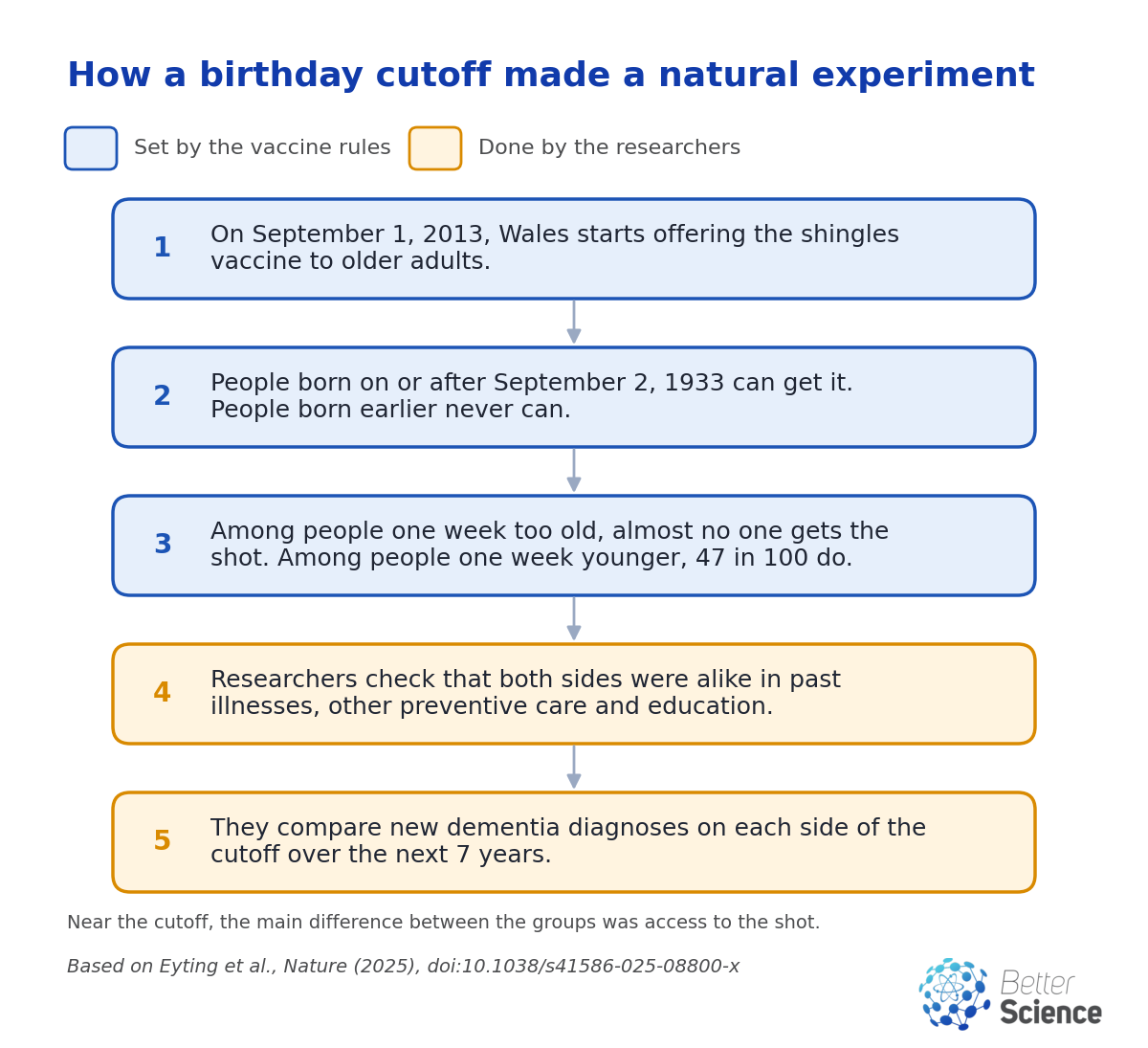
Diagram by Better Science based on Eyting et al., Nature (2025), doi:10.1038/s41586-025-08800-x.
Now think about two people born a week apart in 1933. As the researchers put it, they “are unlikely to differ systematically” apart from their access to the shot. The team checked this. The two sides of the cutoff were similar in other preventive care, past illnesses and education.
Scientists call this method a regression discontinuity design. If something jumps right at the cutoff, the rule that changed on that date is the most likely cause.
Picture two neighbors in Wales, both about 80 years old. One was born on August 30, 1933. The other was born on September 6. They shop at the same store and see the same doctor. Only the younger neighbor is allowed to get the shingles vaccine. Across thousands of such pairs, any gap in dementia is hard to blame on anything but that rule.
That is why this study sits closer to a randomized trial than most studies that simply compare groups. It is still not a trial. But chance, in the form of a birthday, did much of that work for them.
What did the study find?
The team used health records covering 282,541 adults in Wales. Over seven years, 35,307 of them were newly diagnosed with dementia. By my math, that is about 1 in 8 of the whole group, which included people born from 1925 to 1942.
The researchers estimated that being eligible for the vaccine lowered the chance of a new dementia diagnosis by 1.3 percentage points. But fewer than half of eligible people got the shot. So the researchers scaled the result to estimate the effect for people who actually got it.
For people who got the vaccine, new dementia diagnoses fell by 3.5 percentage points over seven years. In plain terms, that is about 3 or 4 fewer diagnoses for every 100 people vaccinated. In relative terms, it was a drop of about 20%, or one-fifth. This does not mean 20 out of every 100 vaccinated people avoided dementia.
The range of likely values was wide. The true drop could have been as small as 0.6 points or as large as 7.1 points. So the exact size is uncertain, even if the direction looks clear.
The team also ran a check. Clinical trials had already shown that this vaccine reduces shingles. The birthday method found a drop in shingles of about 37%, similar in size to what the trials found.
The vaccine did not seem to change other common illnesses or causes of death, or the use of other preventive care. That matters because a hidden effect of healthy habits should show up in many places, not just in dementia.
The benefit was stronger in women than in men. The researchers noted that men had fewer dementia cases, which made the results for men less certain. They said they “cannot exclude the possibility of substantial reductions” in dementia among men too.
Have other studies found the same thing?
Some of the same researchers looked for a similar setup elsewhere. In Australia, the live shingles vaccine became free for people aged 70 to 79 on November 1, 2016 [3]. Again, a birthday decided who could get it.
In that study of 101,219 patients, eligibility lowered new dementia diagnoses by 1.8 percentage points over 7.4 years. The pattern matched Wales, in a different country with a different health system.
The Nature paper also summarized a separate study by the same group, based on death records for England and Wales. It reported that, over nine years, being eligible for the vaccine averted about 1 in 20 deaths with dementia as the main cause. The paper gives only a short summary of that study.
The US team mentioned earlier took a different angle. Around October 2017, the US quickly switched from the older live vaccine to a newer one, called the recombinant vaccine. That team compared 103,837 people vaccinated just after the switch with the same number vaccinated just before it. Nearly all of the first group got the newer shot, and nearly all of the second got the older one. The newer vaccine was linked to 17% more time without a dementia diagnosis over six years. The authors were clear that their study “is observational, and causality cannot be demonstrated.”
What can this study not tell us?
First, the vaccine itself. Wales used a live vaccine. It has now been replaced in the UK, and it is discontinued in the US and many other countries. The researchers stated that their results apply to the live vaccine only. The US study offers a hint about the newer vaccine, but it is a weaker kind of evidence.
Second, age. The results apply mainly to people aged 79 to 80. They say nothing direct about people who get vaccinated at 50 or 60.
Third, how dementia was counted. The study used diagnoses in medical records and death certificates. It did not use brain scans or memory tests. The authors noted that some cases were probably missed or diagnosed late. They argued this problem was unlikely to differ between the two sides of the cutoff, so it should not create a false benefit. That is a fair argument, but records remain an imperfect measure.
Fourth, the mechanism is unknown. One idea is that the vaccine keeps the shingles virus quiet. Flare-ups of this virus have been tied to lasting harm to thinking and to blood vessels in the brain. Another is that the vaccine boosts the immune system in a broader way. The researchers found both ideas plausible, but their tests of mechanism were only exploratory.
Finally, the authors themselves said the result could still be due to chance, even if that is unlikely. They called confirmation in other places “critical”. The Australian result helps, but it shares authors with the Wales study.
Should people get the shingles vaccine to prevent dementia?
Here is the strongest case for caution. A natural experiment is clever, but it is not a randomized trial. Hidden problems can slip through even well-designed studies. In 2024, the US team noted that an early version of the Wales study found a benefit only in women. They noted that this had raised doubts about a cause-and-effect reading. The final paper reported a stronger benefit in women but did not rule out one in men.
Even if the vaccine helps, a 3.5-point drop means most people who would get dementia still would. A shot is not a shield.
I find this study more convincing than the usual health headline, because a birth date is hard to argue with. But I would not tell anyone to get a shingles vaccine to prevent dementia. The good reason to get it is the one we already know: it lowers the chance of shingles. A possible brain benefit is a reason for a proper trial, not a sales pitch.
If you are an older adult, the shingles vaccine is worth a conversation with your doctor for its own sake. Your doctor can tell you which vaccine is offered and whether it fits your health.
Bottom line
A birthday cutoff in Wales gave scientists a rare, fair comparison. People who could get the older shingles vaccine had about one-fifth fewer new dementia diagnoses over seven years if they got the shot. That is strong evidence for a study of this kind, and a similar result in Australia adds weight.
It is still not proof. The study covered one older vaccine, mostly in people around 80, and counted dementia from medical records. We do not know how the vaccine might protect the brain, or whether the newer vaccine does the same. A randomized trial would settle the question far better than any headline can.
References
[1] M. Eyting, M. Xie, F. Michalik, S. Heß, S. Chung, and P. Geldsetzer, “A natural experiment on the effect of herpes zoster vaccination on dementia,” Nature, vol. 641, no. 8062, pp. 438-446, Apr. 2025, doi: 10.1038/s41586-025-08800-x.
[2] M. Taquet, Q. Dercon, J. A. Todd, and P. J. Harrison, “The recombinant shingles vaccine is associated with lower risk of dementia,” Nature Medicine, vol. 30, no. 10, pp. 2777-2781, Jul. 2024, doi: 10.1038/s41591-024-03201-5.
[3] M. Pomirchy, C. Bommer, F. Pradella, F. Michalik, R. Peters, and P. Geldsetzer, “Herpes Zoster Vaccination and Dementia Occurrence,” JAMA, vol. 333, no. 23, pp. 2083-2092, Jun. 2025, doi: 10.1001/jama.2025.5013.
Related Articles