
In 1982, stress and lifestyle were considered the main causes of stomach ulcers. Then a pathologist in Perth, Australia, looked closely at stomach tissue and saw something odd: tiny curved bacteria. A young doctor named Barry Marshall became interested in what he saw.
Marshall and the pathologist, Robin Warren, studied tissue samples from 100 patients [1]. They found the curved bacteria in 58 of them. The bacteria showed up in almost every patient with an ulcer or an inflamed stomach. Their idea went against the accepted view. Two decades later, it won them a Nobel Prize.
Stories like this are why people say science “corrects itself.” However, that only happens when people test claims, share their methods and check each other’s work. When those steps are skipped, mistakes can last for years.
What is the scientific method, really?
Science begins with a question about the world. Why does a plant grow better in one spot? Does a medicine work better than a sugar pill? Scientists suggest an answer and then look for evidence that could prove it wrong.
The steps usually look something like this:
- 1. Observe and ask. Notice a pattern or problem and turn it into a question you can test.
- 2. Learn what is known. Check earlier research so you do not repeat old work.
- 3. Make a testable prediction. A hypothesis is a possible explanation. A good one predicts something that evidence could support or contradict.
- 4. Test it fairly. Run an experiment or collect observations. Plan how you will measure the result before you look at the data.
- 5. Study the evidence. Ask whether the result matches the prediction, how big the effect is, and whether chance, bias or another cause could explain it.
- 6. Revise and test again. A result that goes against your idea is not a failure. It tells you something needs to change.
- 7. Share the work. Publish the methods and results so others can review, repeat or challenge them.
These steps are a general guide. Researchers do not always follow them in order, and they often go back to an earlier step. A broken tool changes the method, and a surprising result leads to a new question. Confidence grows when many studies, done by different people, point the same way.
Why can science catch its own mistakes?
Sharing the work is the step that makes correction possible. A large group of psychologists put it well in 2015. They wrote that claims should earn trust “by the replicability of their supporting evidence” [2]. The status of the person making them should not matter.
A few habits make this work:
- Testable claims. A claim has to predict something that could turn out false. Vague claims cannot be checked.
- Published methods. Scientists describe exactly what they did. That lets outsiders spot a weak step.
- Replication. This means repeating a study with new data to see if the result holds. It is how a single finding becomes a reliable one.
- Independent teams. A group with no stake in the original result is more likely to notice a problem.
- Rewards for being right. A scientist who overturns a popular idea with strong evidence can win great credit, as the ulcer story below shows.
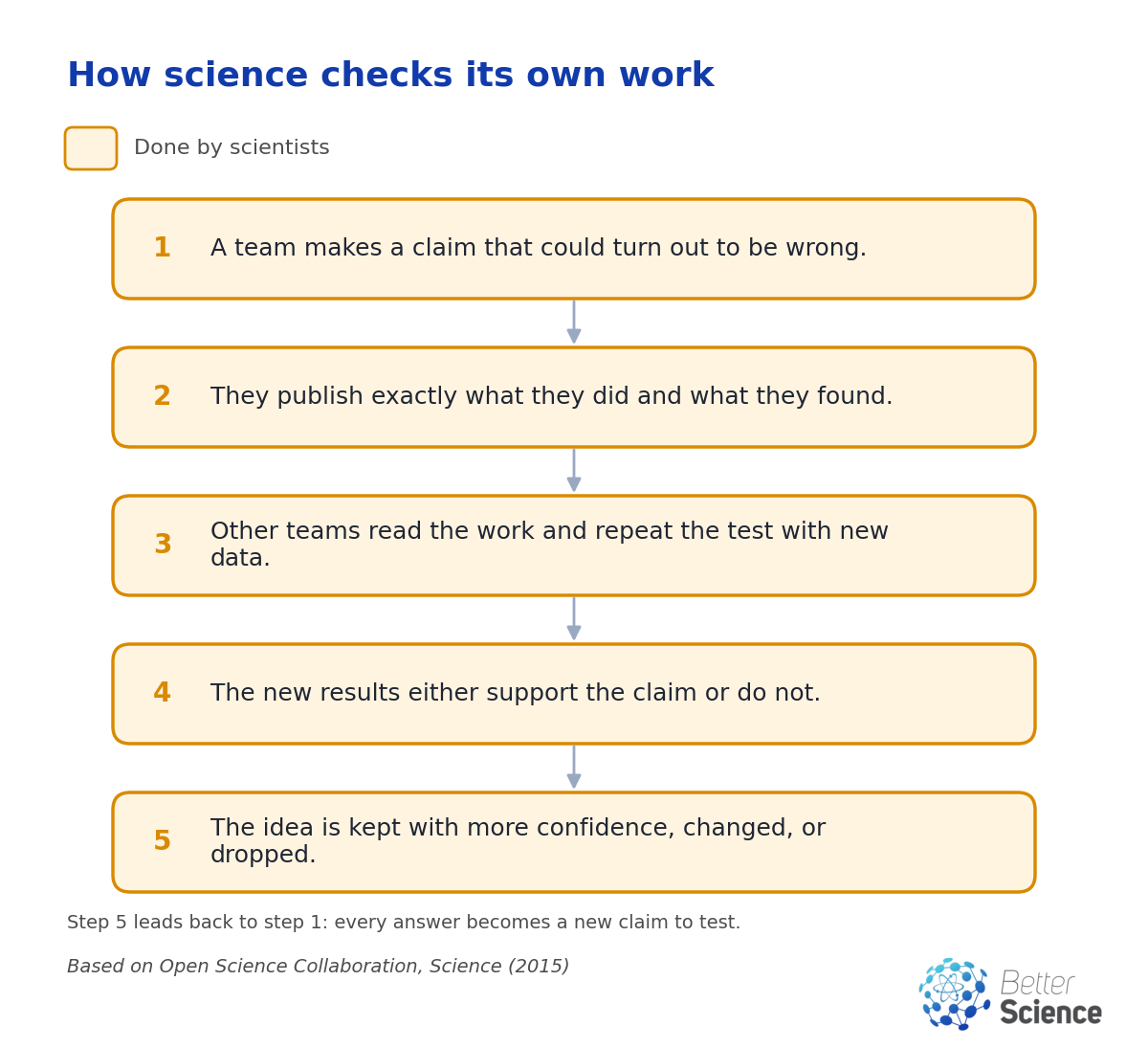
Diagram by Better Science based on Open Science Collaboration, Science (2015), doi:10.1126/science.aac4716.
None of this needs perfect scientists. It assumes people make mistakes and builds in ways to catch them.
What does self-correction look like in real life?
Three real cases show how this works, and how different the paths can be.
An unpopular idea that turned out to be right
When Marshall and Warren published their findings in The Lancet in 1984, they were careful. They wrote only that the bacteria “may be an important factor” in these diseases. Seeing bacteria next to an ulcer shows a link. It does not prove the bacteria cause it.
Proof came from more tests, some by Marshall and Warren and some by others. The Nobel Assembly, which awards the prize in medicine, lists the kinds of proof [3]. They included studies of human volunteers, antibiotic treatment studies and studies of large groups of people. Ulcers treated only with acid-blocking drugs often came back. Patients were cured only when the bacteria were killed.
The bacterium is now called Helicobacter pylori. According to the Nobel Assembly, it causes more than 90% of ulcers in the first part of the small intestine. It also causes up to 80% of stomach ulcers. Ulcers went from a long-term, often disabling problem to one that a short course of antibiotics and acid-reducing drugs can cure. When it gave them the prize in 2005, the Nobel Assembly said the two men had “challenged prevailing dogmas.”
The lesson is that a surprising idea is not accepted just because it is surprising. It is accepted when it keeps passing tests that could have proved it wrong.
A physics team that caught its own mistake
In September 2011, a large physics experiment called OPERA made a startling report. It sent tiny particles called neutrinos from CERN in Geneva, Switzerland. They traveled to an underground lab at Gran Sasso in Italy, about 730 kilometers away. The neutrinos seemed to arrive about 60 billionths of a second earlier than light would [4]. That would mean they moved faster than light.
The team did not claim to have overturned physics. They wrote that they would keep looking for “still unknown systematic effects,” meaning hidden problems with the equipment or method. They also said they “deliberately” offered no theory to explain the result. Instead, they posted the full paper online, with their methods, so others could examine it.
The problem turned out to be surprisingly ordinary. Checks that began in December 2011 and ran until mid-February 2012 found an optical cable that was not properly connected. It weakened the light signal reaching the experiment’s main clock and threw off the timing. The team also found that one clock ran slightly fast. With these problems fixed, the neutrinos arrived right when light would, within the small uncertainty of the measurement.
The lesson is that sharing a strange result openly and modestly is part of the method. The error was found because people went looking for it.

A claim that did not hold up
In another case, Felisa Wolfe-Simon and colleagues reported that a strain of Mono Lake bacteria could use arsenic as a nutrient in place of phosphorus. Science posted their paper online in December 2010 and printed it in 2011. Phosphorus is a normal building block of DNA. The paper went further. It said the bacteria built arsenic into their DNA instead.
Other labs put the claim to the test. In 2012, Science published two separate tests. One team found that arsenic did not help the bacteria grow when phosphorus was scarce [5]. Their DNA held only tiny traces of loose arsenic and none built into the DNA itself. A second team found that the bacteria could not grow when phosphorus was almost entirely removed, even with arsenic available [6]. They concluded that the microbe “is an arsenate-resistant, but still a phosphate-dependent, bacterium.” In other words, it can survive arsenic but still needs phosphorus.
The lesson is that when a claim is testable and clearly described, other labs can check it for themselves.
Is self-correction automatic?
No. Everything above depends on someone doing the checking, and often no one does.
In 2012, the researcher John Ioannidis wrote an essay titled “Why science is not necessarily self-correcting” [7]. He argued that self-correction “does not always happen” by default. If no one tries to repeat a finding, a false result can sit in the scientific record, unchallenged, for a long time.
Three years later, a team of 270 researchers put this to the test. The Open Science Collaboration, the group quoted earlier, repeated 100 published psychology studies. In the original papers, 97% reported a clear, statistically significant result. That means the result was unlikely to be due to chance alone. In the repeated studies, only 36% did, a bit more than 1 in 3. On average, the effects in the new studies were about half as large as in the originals.
This result should be read with care. The authors warned that a failed repeat does not prove the original was wrong. Small differences in how a study is run can change the outcome. Still, the gap was large. The authors also noted that concerns about repeating results are widespread across fields, not just their own.
Part of the problem is how scientists are rewarded. The same authors wrote that “the incentives for individual scientists prioritize novelty over replication.” So a new finding tends to count for more than a careful check of an old one.
Even when an error is caught, the correction may not spread. When a paper is found to be seriously flawed, a journal can retract it. That means formally withdrawing it. A 1998 study looked at 235 retracted papers in medicine and biology, published from 1966 to 1997 [8]. Those papers were cited 2,034 more times after being withdrawn. In a sample of 299 of those later citations, only 19 mentioned the retraction. The rest treated the flawed work as if it were still valid.
Imagine a town map with a road drawn in the wrong place. Someone finally notices and issues a correction. But hundreds of old copies are still in people’s cars. For years, drivers keep following the old map.
That is roughly what happens with retracted papers. The correction exists, but many people never see it.
What helps science correct itself faster?
The same psychology project shows part of the answer. Before running each repeat study, the teams asked the original authors to review their plan. They registered each plan publicly before collecting data. They also posted their materials and data online for anyone to check.
These steps make it harder for errors to survive. A public plan makes it harder to change the goal after seeing the results. Shared data lets others redo the math. In my view, funding and journal space for replication would make checking more worth a scientist’s time. Ioannidis wrote that efficient and unbiased replication is “essential” for science to stay credible.
My reading is that science is able to correct itself, but it is not guaranteed to do so. The tools for catching errors are strong, and the cases above show they work. But they only work when people use them. I trust a finding more when independent teams have repeated it and the data are open. I trust it less when it rests on one exciting study.
The authors of the psychology project ended on a hopeful note. They wrote that their own effort “demonstrates science behaving as it should.” A field checked itself, found a problem and published it.
How can you use scientific thinking?
You do not need a lab to think like a scientist. When you see a claim about health, food or a product, try these questions:
- What is the evidence? Is it a study, a personal story or an opinion?
- Was there a fair comparison? Did the people who got a treatment do better than a similar group who did not?
- Has anyone else found the same thing? One study is a starting point. Several independent studies are much stronger.
- Is the source selling something? A seller has a reason to overstate results.
- Has the finding been corrected or withdrawn? A quick search can show whether a study was later retracted.
Most of all, stay willing to change your mind. Changing a belief when better evidence appears is a strength. It is the scientific method applied to your own thinking.
Bottom line
The scientific method is a careful, organized way to answer questions. It turns questions into tests, and tests into evidence that other people can examine. Scientists are not always right. The real strength of the method is that it gives everyone a way to find out when they are wrong. The ulcer, neutrino and arsenic cases show this.
That strength has limits. Correction depends on people repeating work, sharing data and paying attention to retractions, and those things do not always happen. Science is still one of our best tools for learning how the world works. It works best when we remember that its self-correction is something people have to keep doing.
References
[1] B. J. Marshall and J. R. Warren, “Unidentified curved bacilli in the stomach of patients with gastritis and peptic ulceration,” The Lancet, vol. 323, no. 8390, pp. 1311-1315, Jun. 1984, doi: 10.1016/S0140-6736(84)91816-6.
[2] Open Science Collaboration, “Estimating the reproducibility of psychological science,” Science, vol. 349, no. 6251, Art. no. aac4716, Aug. 2015, doi: 10.1126/science.aac4716.
[3] The Nobel Assembly at Karolinska Institutet, “Press release: The Nobel Prize in Physiology or Medicine 2005,” NobelPrize.org, Oct. 3, 2005. [Online]. Available: https://www.nobelprize.org/prizes/medicine/2005/press-release/
[4] The OPERA Collaboration, T. Adam, N. Agafonova, A. Aleksandrov, O. Altinok, P. Alvarez Sanchez, et al., “Measurement of the neutrino velocity with the OPERA detector in the CNGS beam,” Journal of High Energy Physics, vol. 2012, no. 10, Art. no. 93, first version posted as arXiv:1109.4897v1 in Sep. 2011, final version Oct. 2012, doi: 10.1007/JHEP10(2012)093.
[5] M. L. Reaves, S. Sinha, J. D. Rabinowitz, L. Kruglyak, and R. J. Redfield, “Absence of detectable arsenate in DNA from arsenate-grown GFAJ-1 cells,” Science, vol. 337, no. 6093, pp. 470-473, Jul. 2012, doi: 10.1126/science.1219861.
[6] T. J. Erb, P. Kiefer, B. Hattendorf, D. Günther, and J. A. Vorholt, “GFAJ-1 is an arsenate-resistant, phosphate-dependent organism,” Science, vol. 337, no. 6093, pp. 467-470, Jul. 2012, doi: 10.1126/science.1218455.
[7] J. P. A. Ioannidis, “Why science is not necessarily self-correcting,” Perspectives on Psychological Science, vol. 7, no. 6, pp. 645-654, Nov. 2012, doi: 10.1177/1745691612464056.
[8] J. M. Budd, M. Sievert, and T. R. Schultz, “Phenomena of retraction: reasons for retraction and citations to the publications,” JAMA, vol. 280, no. 3, pp. 296-297, Jul. 1998, doi: 10.1001/jama.280.3.296.
Related Articles