Could a COVID shot help cancer treatment work better? In 2025, a study in Nature suggested it might. People with lung cancer who got a COVID mRNA vaccine near the start of immunotherapy lived much longer than those who did not.
That is a hopeful idea, because the vaccine is already widely available. But a link in a few hundred patients at one hospital is not proof. So a team in France checked the idea in almost every adult in the country who started this kind of treatment.
Their answer, published in Nature Medicine in September 2026, is more modest. Vaccinated patients had a lower death rate in the first few months. After about a year, the death rates were about the same, but a small survival gap remained. Other vaccines, including a pneumonia vaccine, showed a similar early pattern. So it is hard to credit the link to mRNA. Healthier people being more likely to get vaccinated, or a general immune boost from any vaccine, could explain it.
What did the first study claim?
Immunotherapy drugs called checkpoint inhibitors take the brakes off the immune system so it can attack a tumor. They have changed treatment for lung cancer, melanoma and many other cancers. But many patients do not benefit, often because their tumors draw little attention from immune cells.
The 2025 study was led by Adam Grippin and colleagues [1]. They argued that a COVID mRNA vaccine could wake up the immune system and help these drugs work. In mice, the vaccine set off a burst of an alarm signal called type I interferon. That helped immune cells find and attack tumors, especially when the mice also got a checkpoint drug.
The team then looked at patient records from one large US cancer center. They found 180 people with advanced non-small cell lung cancer, the most common type. Each got a COVID mRNA shot within 100 days before or after starting a checkpoint drug. They compared them with 704 patients on the same kind of drug who did not get a COVID shot.
The difference was large. Half of the vaccinated patients were still alive at 37.3 months, compared with 20.6 months for the others. By my arithmetic, that is a gap of about 17 months. A smaller group of melanoma patients showed a similar pattern.
What did the French study do?
The French team, led by Joe-Elie Salem and Florence Tubach, used the country’s national health database [2]. It covers nearly everyone who lives in France. They found 95,015 adults who started a checkpoint drug between late December 2020 and March 2023.
That is a much bigger and broader group. About half had lung cancer, and the rest had melanoma, kidney, bladder, head and neck, liver and other cancers. The median age was 67.
The team asked two questions. First, did people who got a COVID mRNA shot in the 100 days before starting treatment live longer? Second, among people with no COVID shot in those 100 days, did getting one in the 100 days after starting make a difference?
In this study, unvaccinated means no COVID shot in that 100-day window. It does not mean the person never had a COVID shot.
They also tried to make the groups fair. They adjusted for age, income, type of cancer, other illnesses, recent hospital stays and past vaccine habits, among other things. The study was observational, which means the researchers studied what already happened instead of assigning people to groups.
What did they find?
People who got a COVID mRNA shot before starting treatment did a little better at first. Three months in, about 86.0% of them were alive, compared with 84.5% of unvaccinated patients. That is a gap of 1.5 percentage points. These are the study’s estimates after adjusting for the differences it could measure.
The gap did not grow after that, but it did not vanish either. At two years, 43.5% of the vaccinated group was alive, compared with 42.5% of the others. Half of the vaccinated patients were alive at 18.2 months, compared with 17.3 months for the unvaccinated. That is about one extra month, not 17.
The timing matters too. In the first three months, the death rate among patients still alive was about 10% lower in the vaccinated group. That is a relative drop. It does not mean 10 more people out of every 100 survived. After a year, the two groups were dying at about the same rate. The small gap that built up early simply carried forward. The authors describe the link as “modest, transient and not specific to COVID-19 mRNA vaccines.”
People who got a COVID shot in the 100 days after starting treatment showed a somewhat bigger gap. Half of them were alive at 21.5 months, compared with 19.0 months for those who did not get one. At one year, 60.6% were alive, compared with 57.2%. At two years, it was 43.9% compared with 41.3%.
These French numbers are not a like-for-like match with the 17-month gap from the first study. That study looked only at advanced lung cancer and combined shots before and after the start of treatment. The French study covered many cancers and looked at the two time windows separately.
Why does a pneumonia vaccine matter here?
This is the most useful part of the French study. The team ran the same comparison with other vaccines, not just COVID mRNA shots.
If the mRNA shot had a special effect on the immune system, you would expect the strongest link with that shot. That is not what they found. In the first month after starting treatment, the death rate was lower in people who had recently had other vaccines too. Each figure below is a relative drop, from a separate comparison with patients who had not had that vaccine:
- COVID mRNA vaccine: about 10% lower
- Non-mRNA COVID vaccine: about 20% lower
- Any non-COVID vaccine: about 15% lower
- Pneumonia vaccine: about 32% lower
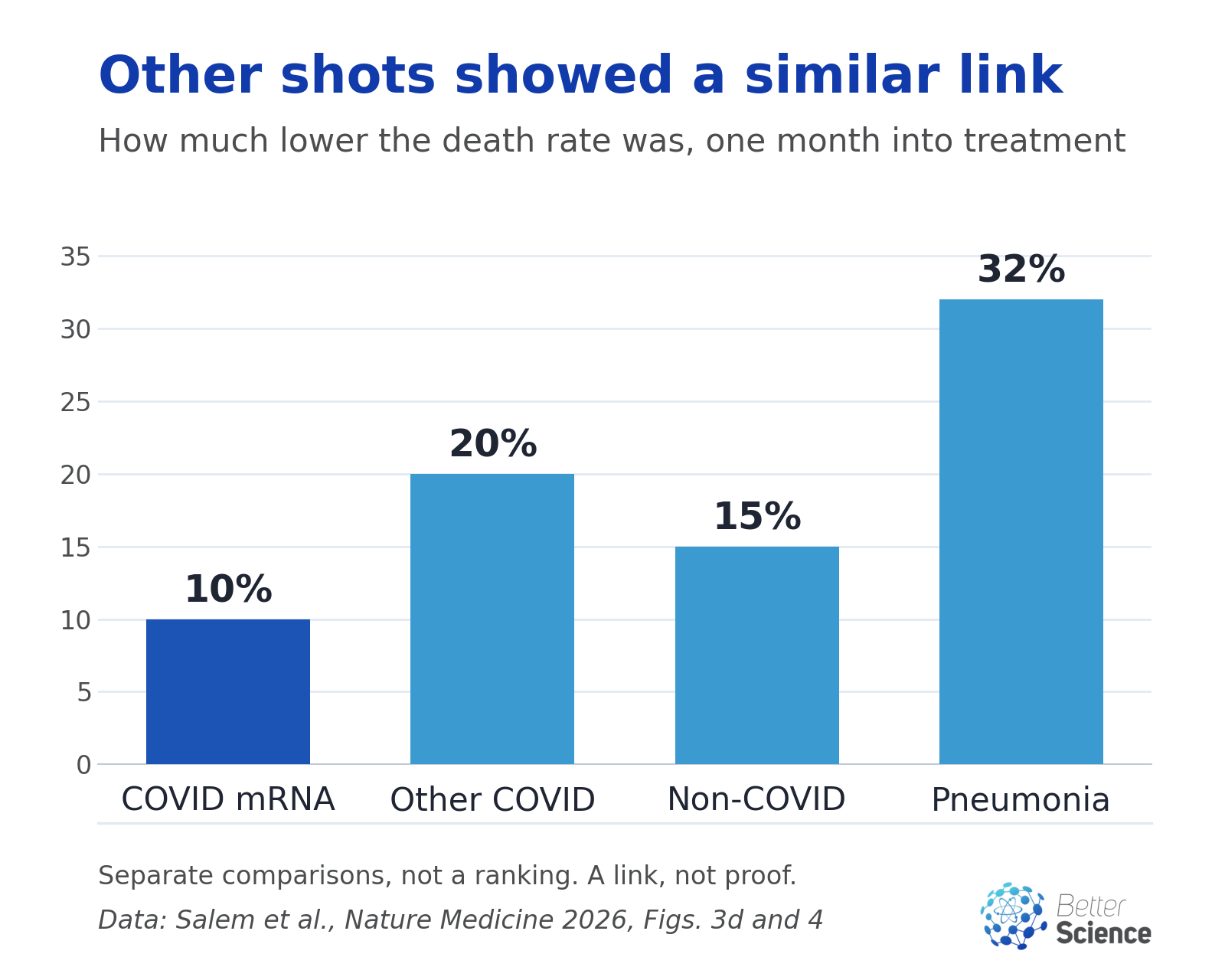
Chart by Better Science from data in Salem et al., Nature Medicine (2026), Figs. 3d and 4, doi:10.1038/s41591-026-04640-y.
A pneumonia shot does not use mRNA, and it was not made to stir up this kind of alarm signal. Yet it showed a similar link. These were separate comparisons, so they do not show that one vaccine works better than another. Having COVID itself in the months before treatment showed no link with survival. The authors note that the harms of infection could have hidden any immune boost.
One explanation the authors call plausible is the healthy vaccinee effect. To get a shot, you have to be alive, steady enough to go out and in regular touch with your doctors. People who are getting sicker fast often skip routine shots. So the vaccinated group may start out a bit healthier, in ways that records do not fully capture. The authors also say a general immune boost from any vaccine could cause the same pattern, and their data cannot tell these two ideas apart.
Imagine two people starting immunotherapy in the same week. One feels well enough to stop at the pharmacy for a booster on the way home. The other is too tired to leave the house and misses it. A year later, the first person is more likely to be alive. The shot may not be the reason. The first person was doing better to begin with.
The French team checked for this in other ways too. They looked at events that a vaccine should not affect, like hip fractures and cataract surgery, and found no clear difference. But they say this check gives “only limited reassurance.” Their database had no direct measure of how well each patient was able to function day to day. That is a key part of the healthy vaccinee effect.
Why were the two studies so different?
Several reasons may explain the gap. The first study was much smaller and came from one hospital. Small studies can show large effects by chance, and patients at one large cancer center may not be typical of patients elsewhere.
The French authors also point to possible biases in the first study’s design. One is timing. The first study’s comparison group included patients treated from 2015, before COVID vaccines existed. The first team did report that the result held when they used only patients treated during the pandemic. The French study included only patients who started treatment after vaccines were available. It also used a method that accounts for the time patients had to survive before they could get a shot after starting treatment. These choices remove some sources of bias, but not all.
The first study also checked pneumonia and flu shots and found no survival benefit with them. The French study linked a pneumonia shot, and other non-COVID vaccines as a group, to fewer early deaths too. A link that also shows up with other vaccines is much harder to credit to mRNA.
Is the immune boost idea dead?
No. The mouse experiments in the first study are real biology, and the French team says a biological effect is still possible. Their data cannot tell a small real effect apart from the healthy vaccinee effect.
The bigger gap after starting treatment could fit a real immune effect. But the French authors note it could also reflect a stronger healthy vaccinee effect in that window. Patients who stay well enough to get a shot during treatment tend to be doing better.
The French study did not find anything close to the 17-month gap that made the first study so striking. But an observational study cannot measure the true size of any real boost, and the two studies looked at different patients.
My reading is that the French study did what good follow-up work should do. It tested an exciting claim in a much bigger group and checked for other explanations. The large benefit did not show up at that scale, and similar patterns appeared with other vaccines. The useful lesson is that one hospital’s records, however careful, can make a hopeful idea look stronger than it is.
That is not a failure of the first team. Small studies are how ideas like this get noticed. Large studies are how we learn how much of the idea survives.
What should patients take from this?
There is good news in the French data. Getting a COVID shot around the start of immunotherapy was not linked to worse survival. Some patients and doctors had worried that a vaccine might interfere with treatment or trigger dangerous immune side effects. The authors say their results should reassure them about survival. The study did not directly measure immune side effects.
But the results do not support timing a COVID shot to boost cancer treatment. The authors write that their results should not be read as evidence that vaccination makes these drugs work better against cancer. If you are on immunotherapy, the reason to get vaccinated is the usual one: protection from infection. Your cancer care team can tell you when a shot fits your treatment.
Bottom line
In France, a COVID mRNA shot near the start of cancer immunotherapy was linked to a lower death rate in the first few months. It was also linked to a small survival gap that lasted. The point when half of patients had died came about one month later with a shot before treatment. It came about two and a half months later with a shot after treatment began. Other vaccines showed a similar early pattern, so the link does not seem special to mRNA. Healthier patients being more likely to get vaccinated is one plausible explanation.
Both studies looked back at records, so neither can prove cause and effect. Only a randomized trial, where chance decides who gets the shot and when, could show whether the vaccine itself helps the cancer drugs work.
Correction, November 2, 2026: An earlier version said the second French analysis looked at people getting their first COVID shot. It looked at people with no COVID shot in the 100 days before treatment, some of whom may have had shots earlier. We also added the survival figures for that analysis.
References
[1] A. J. Grippin, C. Marconi, S. Copling, N. Li, C. Braun, C. Woody, et al., “SARS-CoV-2 mRNA vaccines sensitize tumours to immune checkpoint blockade,” Nature, vol. 647, no. 8089, pp. 488-497, Nov. 2025 (online Oct. 22, 2025), doi: 10.1038/s41586-025-09655-y.
[2] J.-E. Salem, R. Curmin, A. Ajrouche, Y. De Rycke, J. Cadranel, and F. Tubach, “COVID-19 vaccination around immune checkpoint inhibitor start and survival in a nationwide cohort of patients with cancer,” Nature Medicine, vol. 32, no. 10, pp. 3633-3643, Oct. 2026 (online Sep. 10, 2026), doi: 10.1038/s41591-026-04640-y.
Related Articles