
On February 3, 2025, the journal Nature Medicine published a short study. Scientists at the University of New Mexico reported that human brains contain tiny pieces of plastic [1]. They also reported that brains from 2024 held more plastic than brains from 2016. Brains from people who had dementia held far more plastic still.
I think the study should be taken seriously and read carefully. It shows that scientists can detect what looks like plastic in brain tissue, but it does not show that the plastic caused dementia or any other disease. The amounts reported are also less certain than they first appear.
What did the scientists actually measure?
The researchers worked with the office that performs autopsies in New Mexico. They took small pieces of brain, liver and kidney from people who had died in 2016 and in 2024. All brain samples came from the frontal cortex, the part of the brain just behind the forehead. Each time point included about 20 to 28 people.
Older brain samples from East Coast brain banks, from 1997 to 2013, had lower levels. The authors noted that the difference could come from where the brains came from, not only from when.
The typical brain sample from 2016 held 3,345 micrograms of plastic per gram of tissue. In 2024, the typical sample held 4,917 micrograms per gram. That is a rise of about 50% over 8 years, if the method is accurate.
Brain levels were also 7 to 30 times higher than liver and kidney levels. On average, polyethylene made up 75% of the plastic in the brain. Oddly, older people did not have more plastic than younger people.
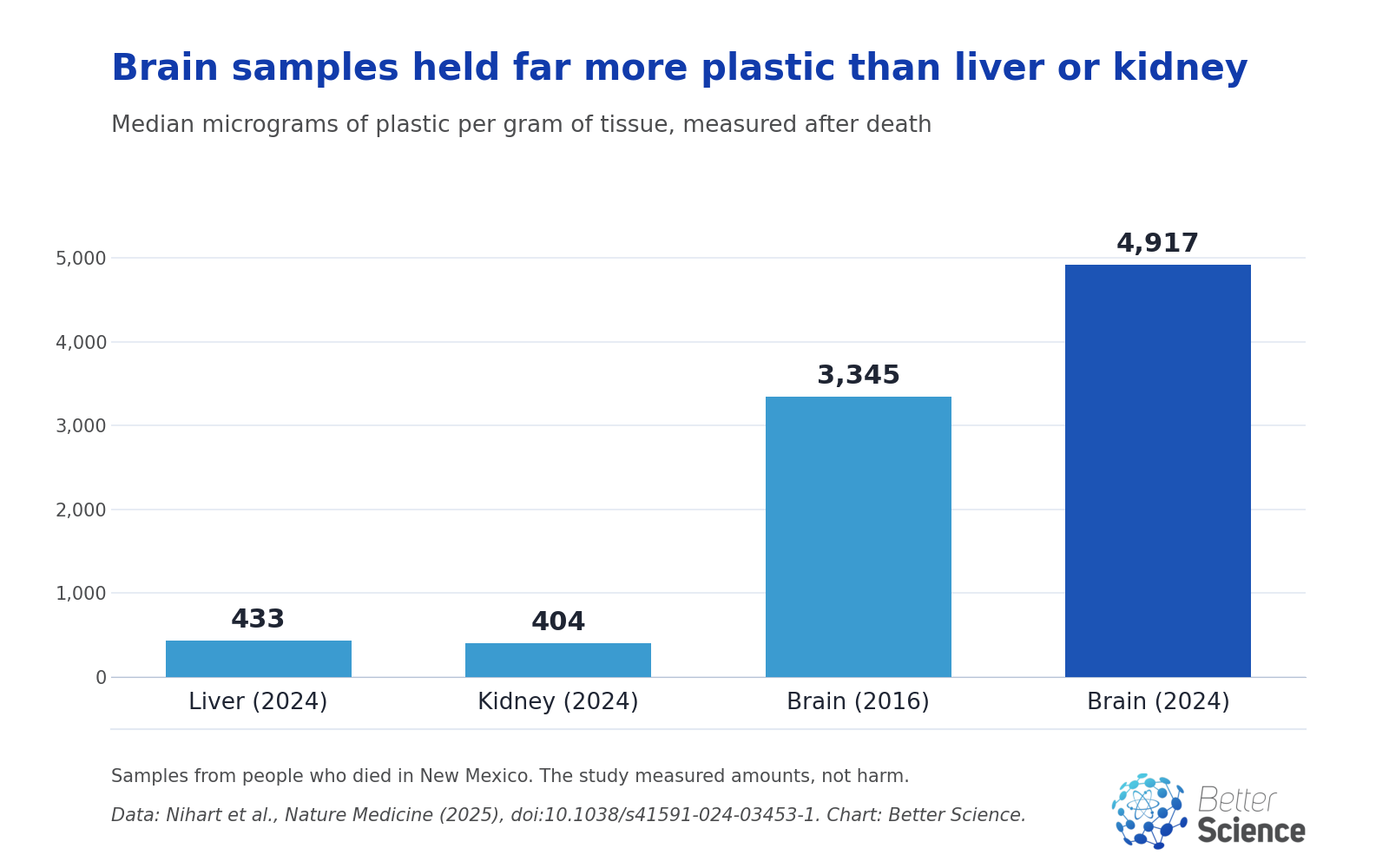
Chart by Better Science from data in Nihart et al., Nature Medicine (2025), doi:10.1038/s41591-024-03453-1.
How do you weigh plastic you cannot see?
The team suspected that most of these particles were too small to see with an ordinary microscope. With a more powerful electron microscope, they saw mostly shards or flakes. Most were about 100 to 200 nanometers long. A nanometer is one billionth of a meter.
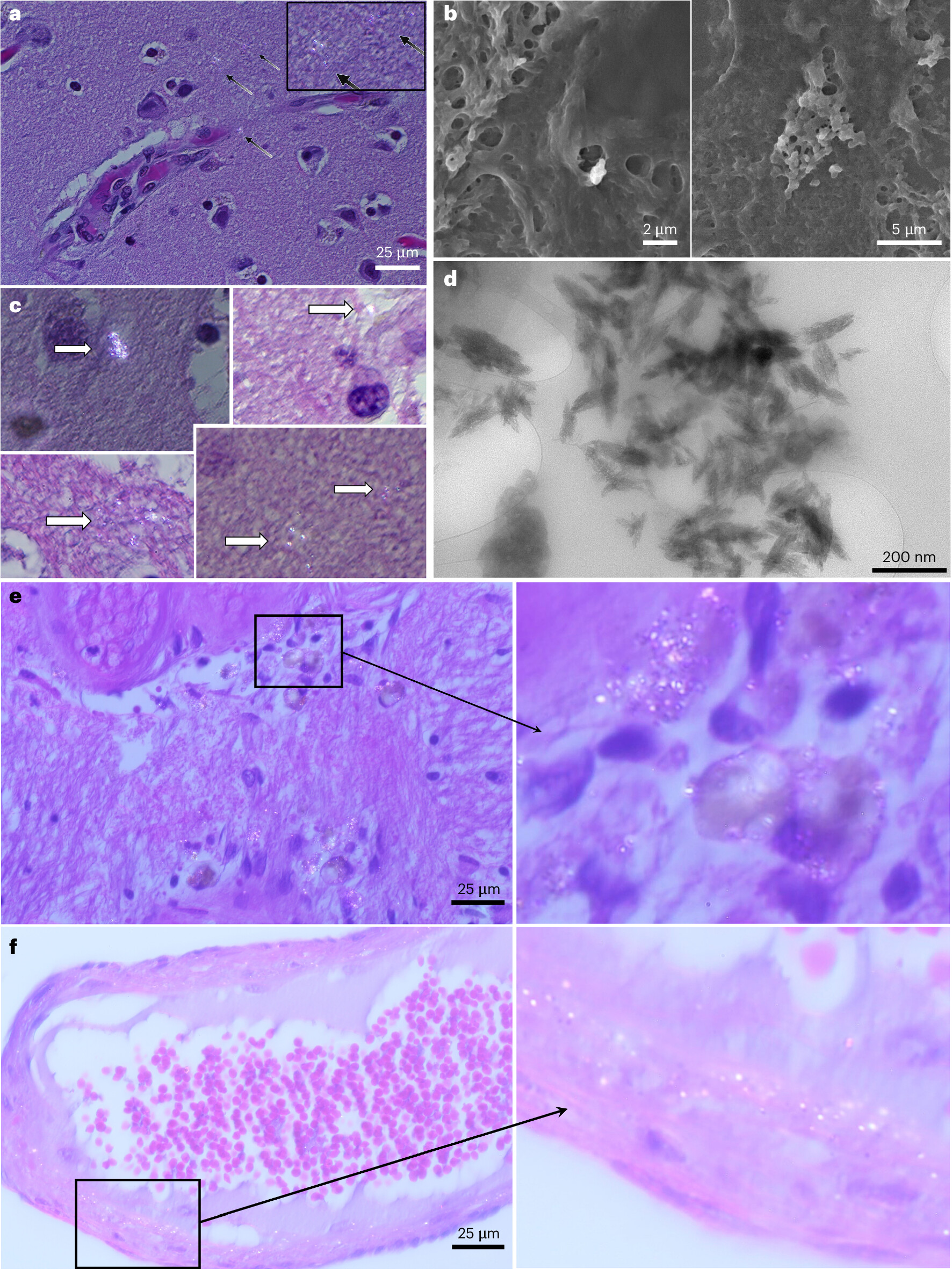
Source: Nihart et al., Nature Medicine (2025), Fig. 2, doi:10.1038/s41591-024-03453-1. Reproduced unchanged under a CC BY-NC-ND 4.0 license.
So the team used chemistry instead of counting. First, they dissolved about half a gram of tissue in a strong chemical for at least 3 days. Then they spun the liquid very fast to collect the solid bits that did not dissolve.
Next, they heated those solids until they broke apart. A lab instrument then identified the chemicals in those pieces. The team matched the chemical patterns to 12 common types of plastic.
The authors listed several weak points. The method is new and has not yet become a standard test for human tissue. When both labs measured the same sample more than once, their results varied by about 25%.
The leftover solids also still held some unknown tissue material, which could confuse the readings. The authors noted that fats are known to throw off measurements of polyethylene.
Contamination is another worry, since plastic is everywhere in labs. The authors wrote that tissue collections from past decades “were not focused on minimizing external plastic contamination”. They ran blank samples to check for stray plastic. They also pointed out that the 2016 samples sat in storage for years longer, yet held less plastic.
A second lab at Oklahoma State University tested five of the 2016 brain samples. Its results were consistent with the main lab’s results. That is reassuring, but five samples is a small number to check.

Does plastic in the brain cause dementia?
The team tested brain samples from 12 people who had dementia. The typical sample held 26,076 micrograms of plastic per gram. That was higher than any group without dementia. Still, the study cannot say whether plastic caused the disease.
Finding more plastic in sick brains is an association. That means two things show up together. It does not tell you which one caused the other, or whether a third factor explains both.
The authors made this point themselves. They noted that dementia shrinks brain tissue and weakens the barrier that protects the brain from the blood. It can also slow the brain’s cleanup systems. Any of these changes could let more particles in or keep them from leaving. In their words, “no causality is assumed from these findings”.
Imagine a house with a leaky roof. Over the years, dust and leaves pile up in the attic. Someone finds the pile and blames it for the leaks. In fact, the leaks helped the pile grow. In the same way, a damaged brain may collect more plastic.
The study’s own conclusion is plain: “These data are associative and do not establish a causal role for such particles affecting health”. Twelve cases is also a small group.
Other studies have found plastic in human tissue. In 2024, a team in Italy studied 304 patients who had surgery to remove fatty buildup from a neck artery [2]. Among those followed, 58.4%, about 6 in 10, had polyethylene in the buildup. Those patients had a higher risk of heart attack, stroke or death over almost three years. Yet those authors also wrote that “our results do not prove causality”. They added that lab contamination “cannot be firmly ruled out”.
What has happened since the study came out?
In March 2025, the authors published a correction [3]. Two images in the extra online material were duplicates and were removed. Some size markers on images were drawn wrong and were fixed. A missing step in the sample preparation was also added, and a table of particle counts in the extra material was made clearer. The notice says removing the duplicate images does not change the chemical readings in one of the extra tables.
A correction is not a retraction. The journal has not withdrawn the paper, and I found no editor’s warning attached to it.
In November 2025, the journal published a formal critique from another group of scientists [4]. They wrote that the study “appears to face methodological challenges, such as limited contamination controls and lack of validation steps”.
The original authors replied in the same issue [5]. They called the exchange a chance to discuss uncertainties. Those uncertainties affect even the best current methods for finding tiny plastics in human tissue. The critics had questioned the dissolving step, some quality checks and possible interference from fatty molecules. The original authors had already raised that last point in their study.
What should you take from this?
In my view, tiny particles that look like plastic can be found in human brains. The measured amounts may be rising, and they appear higher in brains affected by dementia. All of this comes from small groups of people, samples from one part of the brain, and a method that experts still debate.
Plastic in the brain is a real reason for concern and for better research. It is not yet a proven cause of dementia, and I would treat the exact amounts with some doubt until other labs confirm them with standard methods.
Larger studies that follow living people over time would help. So would standard tests that give the same answer in different labs.
Until then, be wary of any headline or product that claims to know how plastic affects your brain. The scientists behind this study were careful not to make that claim. In my view, readers and reporters should be just as careful.
References
[1] A. J. Nihart, M. A. Garcia, E. El Hayek, R. Liu, M. Olewine, J. D. Kingston, et al., “Bioaccumulation of microplastics in decedent human brains,” Nature Medicine, vol. 31, no. 4, pp. 1114-1119, Apr. 2025, doi: 10.1038/s41591-024-03453-1.
[2] R. Marfella, F. Prattichizzo, C. Sardu, G. Fulgenzi, L. Graciotti, T. Spadoni, et al., “Microplastics and Nanoplastics in Atheromas and Cardiovascular Events,” New England Journal of Medicine, vol. 390, no. 10, pp. 900-910, Mar. 2024, doi: 10.1056/NEJMoa2309822.
[3] A. J. Nihart, M. A. Garcia, E. El Hayek, et al., “Author Correction: Bioaccumulation of microplastics in decedent human brains,” Nature Medicine, vol. 31, no. 4, p. 1367, Apr. 2025, doi: 10.1038/s41591-025-03675-x.
[4] F. A. Monikh, D. Materić, E. Valsami-Jones, H.-P. Grossart, K. Altmann, R. Holzinger, et al., “Challenges in studying microplastics in human brain,” Nature Medicine, vol. 31, no. 12, pp. 4034-4035, Dec. 2025, doi: 10.1038/s41591-025-04045-3.
[5] M. J. Campen, A. B. West, M. Garcia, R. Gullapalli, and E. El Hayek, “Reply to: Challenges in studying microplastics in human brain,” Nature Medicine, vol. 31, no. 12, pp. 4036-4037, Dec. 2025, doi: 10.1038/s41591-025-04046-2.
Related Articles