
After surgery and chemotherapy for colon cancer, many people ask the same question. Is there anything else I can do to keep the cancer from coming back? For years, the honest answer about exercise was that it probably helps, but no one was sure.
That changed a little in June 2025. A team of researchers published a large trial in the New England Journal of Medicine [1]. They randomly placed colon cancer survivors into two groups. One group got a three-year exercise program with a coach. The other group got health education materials. After about eight years, fewer people in the exercise group had their cancer return or a new cancer appear, and fewer had died.
I think the result is important. However, it applies to a specific group of colon cancer survivors, and exercise is not a replacement for cancer treatment.
Why was this trial a big deal?
Doctors have long suspected that active people do better after a cancer diagnosis. But most of that evidence came from observational studies. In these studies, researchers watch what people already do and compare how they fare.
The trouble is that active people differ from inactive people in many ways. They may be younger or less sick, and that alone could explain better survival. As the trial’s authors put it, “definitive level 1 evidence is lacking.” In plain terms, doctors wanted the proof a strong randomized trial gives.
In a randomized trial, a computer decides who goes into which group, like a coin toss. That makes the two groups alike on average, even in ways no one measured. This trial’s method also kept them balanced on cancer stage and body weight. If one group then does better, the treatment it received is the most likely reason.
Who was in the study?
The trial, called CHALLENGE, took place at 55 cancer centers. From 2009 through 2024, it enrolled 889 people. Everyone had surgery to remove their colon cancer. They had also finished chemotherapy in the past 2 to 6 months.
Nine in 10 had cancer that had spread to nearby lymph nodes. The rest had cancer with other features that raised the risk of return. Even after surgery and chemotherapy, the authors note, the cancer comes back in 20 to 40% of people like this.
People also had to be fairly inactive, with less than 150 minutes of moderate or hard exercise a week. Yet they had to be well enough to finish a short walking test. Most came from Canada and Australia. Their median age was 61, meaning half were younger and half were older. Just over half were women.
What did the exercise group actually do?
The exercise group got the same health materials as the other group, plus an exercise guidebook. They also had three years of support from a certified physical activity coach.
The support came in stages. For the first six months, people met the coach in person every two weeks for a coaching session and a supervised workout. They were also encouraged to do a supervised workout in the weeks between. For the next six months, coaching stayed every two weeks, but it could be by phone or video. For the last two years, it was once a month.
The goal was to add a set amount of aerobic exercise, meaning exercise that raises your heart rate, within six months. Then people were to keep it up. People chose their own activity, and how often, how hard and how long they did it. The authors say the increase people reached was like adding 45 to 60 minutes of brisk walking three or four times a week. Jogging for 25 to 30 minutes as often would do the same.
The other group received general health education materials that encouraged physical activity and healthy eating. Both groups got normal cancer follow-up care. So the trial compared a coached program with good advice alone. It did not compare exercise with doing nothing.
What did the study find?
The main result was about disease-free survival. That means staying alive with no return of the cancer and no new cancer of any kind. After five years, 80.3% of the exercise group were alive and cancer free. In the education group, 73.9% did.
In plain numbers, that is about 6 more people in every 100. Over the whole follow-up, 93 people in the exercise group had their cancer return, got a new cancer or died. In the education group, 131 did.
Most of the difference between the groups came from two kinds of events. Fewer people in the exercise group got a new cancer (23 versus 43 people). Fewer also had their colon cancer come back in the liver (16 versus 29).
You may see headlines saying exercise cut the risk by 28%. That is a relative number that compares the two groups. It does not mean 28 out of every 100 people were spared. The plain difference in people, about 6 in 100, is more useful for a person making choices.
The trial also looked at deaths. After eight years, 90.3% of the exercise group was alive, compared with 83.2% of the education group. That is about 7 more people alive out of every 100. In total, 41 people died in the exercise group and 66 in the education group.
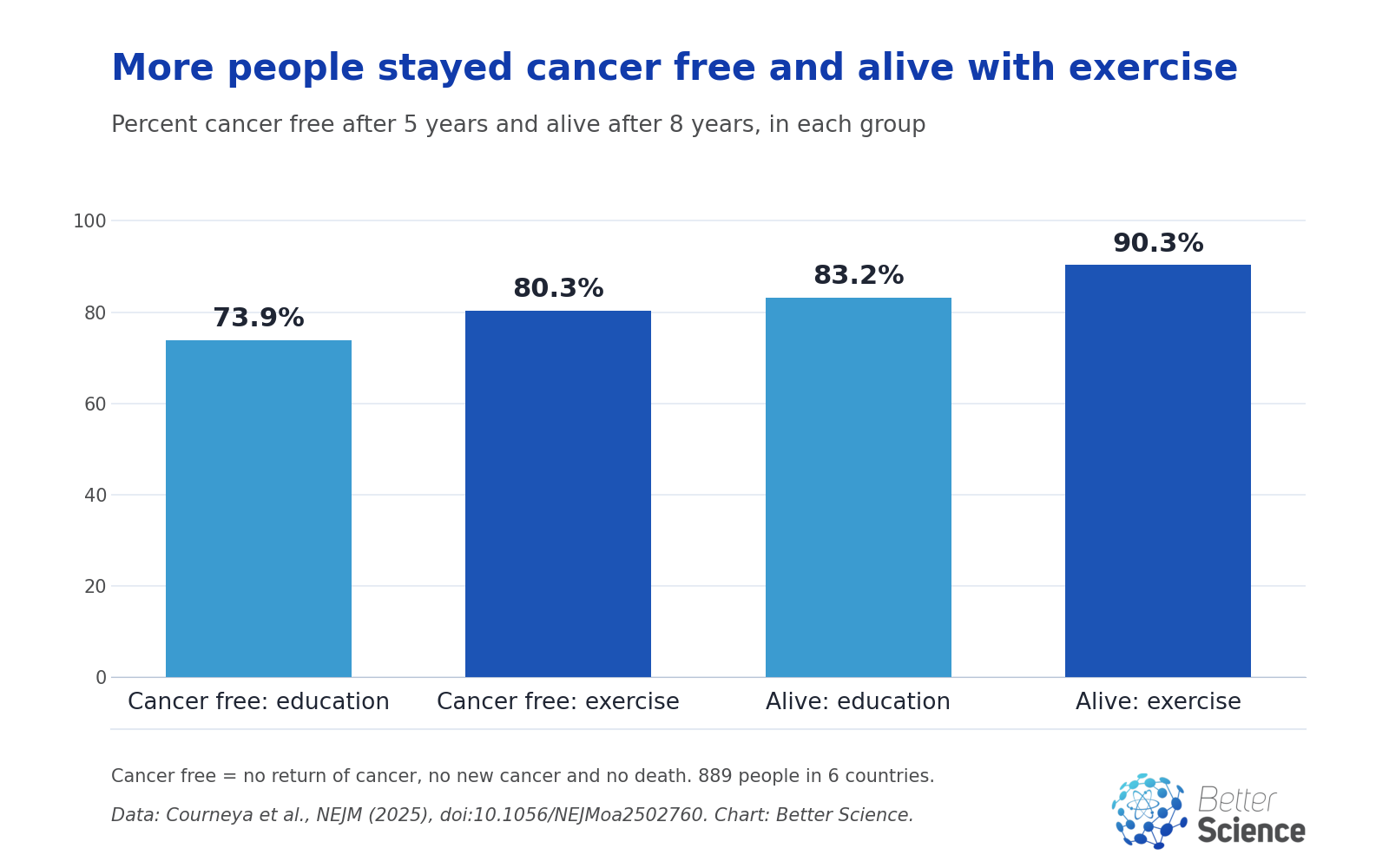
Chart by Better Science from data in Courneya et al., New England Journal of Medicine (2025), doi:10.1056/NEJMoa2502760.
The authors worded these two results differently. They said the program led to “significantly longer disease-free survival.” For overall survival, they said only that the results fit with longer life. Survival was not the trial’s main question, so they were more careful with it.
Does this prove exercise lowers the risk?
For people like those in this trial, the evidence is strong. Because the groups were formed by chance, they started out alike. The authors report that the groups were indeed well balanced. That is why this trial is more convincing than earlier studies.
The result also matches the older evidence. One expert said that observational studies had suggested about 25% lower risk of dying from colorectal cancer with this much exercise [2]. She called the trial’s findings “quite consistent with those previous observational studies.” This agreement between a strong trial and years of weaker studies makes the finding more believable.
Still, this is a single trial, and its result is not exact. Even allowing for chance, the true benefit at five years could be as small as less than 1 extra person per 100. It could also be as large as about 12 per 100. The best estimate is 6.
The trial also saw fewer events than planned: 224 cancer returns, new cancers or deaths instead of the 380 the authors aimed for. Fewer events make the result less certain.
We also do not know exactly how exercise helps. Body weight and waist size barely changed, so the authors think weight loss is an unlikely reason. They plan to study blood samples from the people in the trial to learn more.
What are the limits and downsides?
First, there were side effects. Muscle and bone problems happened in 18.5% of the exercise group, compared with 11.5% of the education group. That is about 7 more people in every 100. Doctors judged that 8 of the 79 such problems in the exercise group were related to the program. Side effects rated severe or worse, of any kind, were also more common: 15.4% versus 9.1%. Starting a new routine after cancer treatment carries some risk.
Second, the people in the trial were volunteers. The authors say the trial likely drew healthier, fitter people than average. Because people joined months after chemotherapy, those whose cancer came back very early were not included. One expert noted that “the recruitment was very slow”. She said this suggests it was hard to find people willing to take on such a long program.
Third, people did less over time. They attended 83% of coaching sessions in the first six months but 63% over the last two years. Even so, the exercise group stayed more active for all three years. The education group also became somewhat more active. So the authors think the benefit of exercise compared with no exercise could be even larger.
Fourth, the coached group got much more personal attention. The authors cannot fully rule out that this attention, and not only the exercise, helped. The program also cost money, and we do not know what it would cost to offer widely.
Picture 100 people who have just finished chemotherapy for colon cancer and join a coached exercise program. Five years later, compared with 100 similar people who got only health education materials, about 6 more of them are alive and free of cancer. Most people in both groups would have done well either way.
The program raised each person’s chances of doing well. It did not guarantee a good result for any single person.
Is there a fair case for caution?
Some people might say the benefit is too small to matter. I do not agree. Six more people per 100 staying cancer free is a real gain. One expert said the effect looked about as large as the benefit seen with chemotherapy in earlier studies. The authors also compared it with many approved cancer drugs.
A fairer worry is about who can get this kind of help. The trial tested a program with a personal coach, not just printed advice. Both groups got advice, and only the coached group did clearly better. One expert said support from a doctor and a trainer or physical therapist “will almost certainly be necessary” for most patients. The authors agree that knowledge alone is unlikely to change what patients do. They call on health systems to invest in programs that support behavior change.
For people well enough to do it, this trial moves exercise after colon cancer from a hopeful idea to a tested part of care. In my view, the lesson is about support as well as exercise. Coached, steady support worked better than advice alone, and health systems should plan for it.
This trial does not answer the question for other cancers. This trial only studied colon cancer after chemotherapy, so its results should not be stretched to every cancer.
Bottom line
A large randomized trial found that a three-year coached exercise program, started after chemotherapy for colon cancer, helped more people stay cancer free. Its survival results pointed the same way. About 6 more of every 100 people were cancer free at five years, and about 7 more of every 100 were alive at eight years. The trial applies to people who had finished surgery and chemotherapy and could safely exercise.
If you are in this situation, talk with your cancer care team before starting a program. Ask whether a supervised program or a trained exercise coach is available near you. Exercise does not replace treatment or follow-up visits, but for many survivors, it may be a meaningful thing they can add.
References
[1] K. S. Courneya, J. L. Vardy, C. J. O’Callaghan, S. Gill, C. M. Friedenreich, R. K. S. Wong, et al., “Structured Exercise after Adjuvant Chemotherapy for Colon Cancer,” New England Journal of Medicine, vol. 393, no. 1, pp. 13-25, Jul. 2025 (published online Jun. 1, 2025), doi: 10.1056/NEJMoa2502760.
[2] Science Media Centre, “Expert reaction to randomised trial on physical exercise and reduced risk of recurrence of colon cancer,” Jun. 1, 2025. [Online]. Available: https://www.sciencemediacentre.org/expert-reaction-to-randomised-trial-on-physical-exercise-and-reduced-risk-of-recurrence-of-colon-cancer/
Related Articles