

Most women told they have DCIS are soon booked for surgery. Yet not every case of DCIS turns into invasive cancer. So a hard question keeps coming up. Could some women skip surgery, at least for now, and simply be watched closely?
In December 2024, a team of US researchers shared the first results of a trial called COMET [1]. They randomly split 957 women with low-risk DCIS into two groups. One group got the usual care, which included surgery. The other group had regular mammograms and kept surgery in reserve.
After two years, invasive cancer in the same breast was no more common in the monitoring group. About 4 in 100 women in that group had it, compared with about 6 in 100 in the surgery group. The main limit is that two years is a short time, and the authors themselves say the results could change.
What is DCIS, and why is it treated like cancer?
DCIS stands for ductal carcinoma in situ. The National Cancer Institute describes it as abnormal cells in the lining of the milk ducts [2]. These cells have not broken out into the rest of the breast. It is not invasive cancer. But it can sometimes become invasive over time.
DCIS makes up about 20% to 25% of new breast cancer cases in the United States each year. Most cases are found on a screening mammogram, where they can show up as tiny white specks. More than 98% of people diagnosed with DCIS are alive five years later.
So why is it almost always treated with surgery? The institute explains that doctors “don’t know which cases of DCIS will become invasive.” So most women get the same treatments used for early invasive cancer. These can bring long-term pain, body image changes, sexual problems and menopause symptoms, the COMET authors note.
What did the COMET trial actually do?
The trial ran through 100 US sites between 2017 and 2023, and 83 of them enrolled patients. It enrolled women aged 40 or older with newly found DCIS. The DCIS had to be low or middle grade (grade 1 or 2). It also had to be hormone receptor positive, meaning the cells carry receptors for estrogen or progesterone. If the cells had been tested for a protein called HER2, that test had to be negative.
Two pathologists (doctors who examine tissue samples) had to agree on the diagnosis. Women with a lump or other breast symptoms could not join. Nobody in the trial had any sign of invasive cancer at the start.
The women were then split into two groups by chance. This is called a randomized trial, and it is a fair way to compare two choices.
- Usual care (473 women). Surgery, either removing the area or the whole breast, with radiation if their doctors advised it.
- Active monitoring (484 women). A mammogram of the affected breast every six months, plus physical exams. If something changed, doctors recommended a needle biopsy. Surgery was required if the biopsy found invasive cancer.
Women in either group could choose hormone therapy with their doctor. Anyone in the monitoring group could also choose surgery at any time, for any reason.
What did the study find?
The main question was how many women were diagnosed with invasive cancer in the same breast within two years. Across both groups, 46 women were diagnosed with invasive cancer. The two year rate was 5.9% in the surgery group and 4.2% in the monitoring group. In plain numbers, that is about 6 in 100 women versus about 4 in 100.
At the time of the analysis, 6 women had died. None of the deaths was caused by breast cancer.
The surgery group had slightly more invasive cancer. The difference was small enough that it could be due to chance alone. The trial counted every invasive cancer found after a woman joined. The authors also cite past studies where 5% to 16% of low-risk DCIS cases turned out to hide some invasive cancer.
In my view, there may be a simple reason, though the paper does not spell it out. Surgery removes the whole area for a close look, so hidden invasive cancer gets found right away. In the monitoring group, such hidden cancer may simply show up later.
How did the researchers decide if monitoring was safe enough?
The researchers were not trying to show that monitoring beats surgery. They wanted to know if monitoring was close enough to surgery to be a fair choice.
So before the trial began, they set a limit. If monitoring led to 5 or more extra invasive cancers for every 100 women, it would fail. Fewer than that, and it would pass. They chose this limit with help from past studies, experts and patient advocates.
Imagine testing a cheaper brand of bike helmet. You decide in advance that it passes if it protects nearly as well as the famous brand, within a small, agreed gap. Passing that test does not mean the cheap helmet is better. It means it did not fall short by more than the gap you allowed.
The result was that monitoring did not lead to more invasive cancer. About 4 in 100 women in the monitoring group got invasive cancer, compared with about 6 in 100 in the surgery group. Even allowing for chance, monitoring led to at most about 1 extra cancer per 100 women. That is far below the limit of 5, so monitoring passed.
Some readers may wonder if a limit of 5 was too easy. When the team planned the trial, they expected about 10 in 100 women in the surgery group to get invasive cancer within two years. It turned out to be about 6 in 100. Going from 6 to 11 would nearly double the rate. The authors admit the limit “may be perceived as generous.” A stricter test still gave the same answer.

Did the women stay in their assigned groups?
Many did not. The authors report that 44% of women assigned to surgery chose not to have it. On the other side, 14% of women assigned to monitoring chose not to be monitored.
The team expected some switching. But they “did not anticipate the strong preference for monitoring over surgery.” At the time of the analysis, about 17% of the monitoring group had had surgery, compared with about 56% of the surgery group. So the two groups ended up less different than the plan intended.
A separate report from the same trial suggests that the women who joined may have been especially interested in monitoring [3]. Yet more women in the monitoring group had surgery than had their DCIS actually progress. That suggests some women and their doctors were uneasy about skipping surgery.
Because so many women switched, the trial mostly compares two starting offers: surgery or monitoring. It does not cleanly compare having surgery with not having it. The authors found no obvious differences between those who switched and those who did not. But there could still be differences they could not see.
Was it the monitoring or the hormone therapy?
This question asks what actually kept invasive cancer low. More than 70% of women in the monitoring group took hormone therapy, compared with about 66% in the surgery group. Past studies found that these medicines cut the rate of invasive cancer by about half. The authors say it may have reduced invasive cancer in the monitoring group.
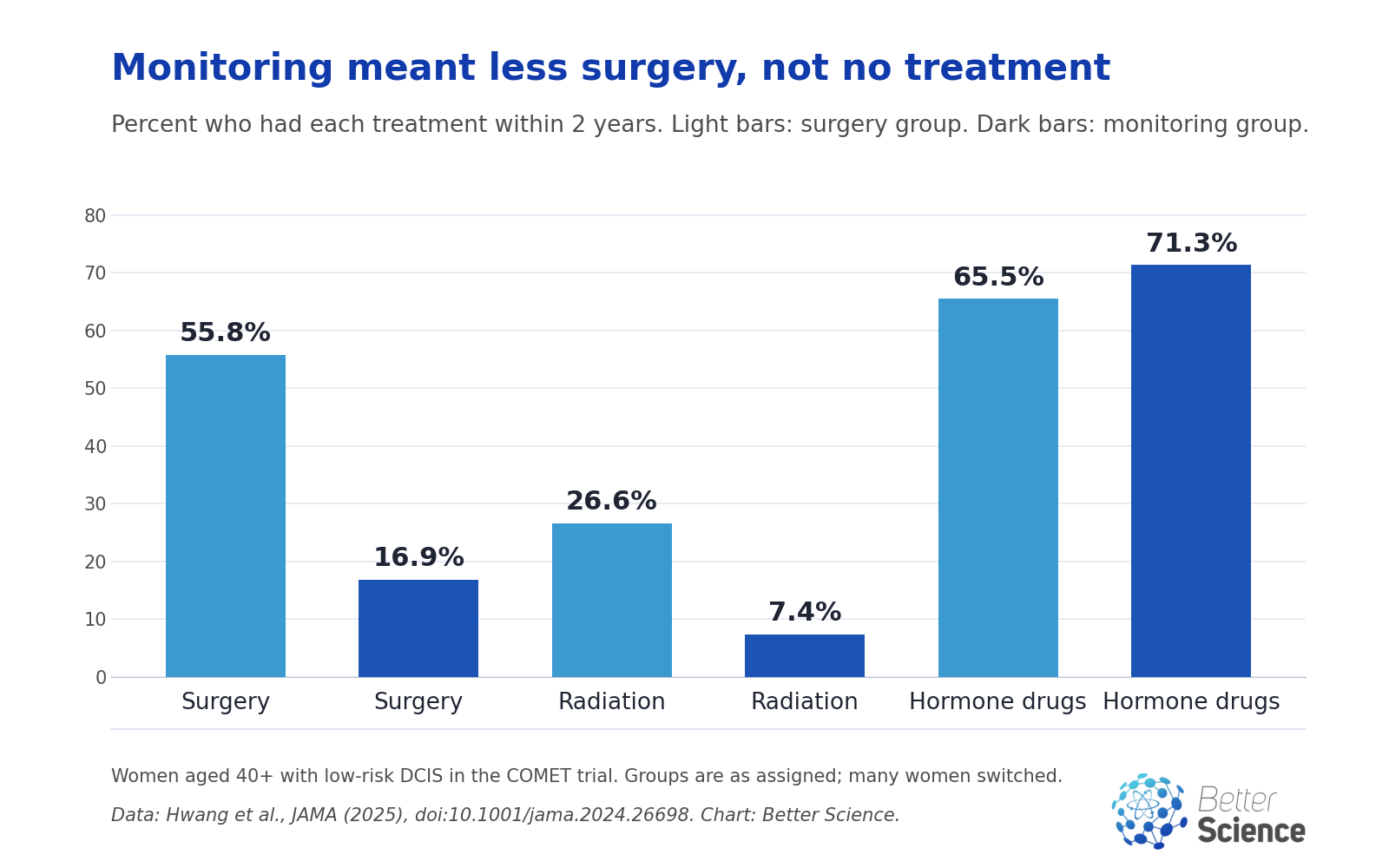
Chart by Better Science from data in Hwang et al., JAMA (2025), doi:10.1001/jama.2024.26698.
So in real life, active monitoring in COMET usually meant monitoring plus hormone therapy. That therapy can bring its own side effects. The trial was not designed to measure how much of the benefit came from hormone therapy. It shows what happened with this whole package, not with watching alone.
How did the women feel?
A common worry is that living with untreated DCIS would cause constant anxiety. The same team checked this with questionnaires over two years.
Quality of life, anxiety, depression, worry about DCIS and symptoms were “comparable between groups,” they reported. Anxiety stayed low on average in both groups. The fear that monitoring would raise anxiety “was not the case for women who enrolled in COMET.”
That is reassuring, but there is one limit. The women who joined had agreed to let chance decide about surgery. My guess is that women who strongly dislike uncertainty may never have signed up.
Why is two years not enough?
This is the trial’s most important limit. When the results came out, half of the women had been followed for about three years or more. The authors expect more invasive cancers over time, “particularly in the active monitoring group.” They write that the results could even be reversed at a later point. Analyses at 5, 7 and 10 years are planned.
A 2025 study, by some of the same researchers, gives a hint of what happens later [4]. It looked back at 1,780 US women who had not had surgery within six months of a DCIS diagnosis. Of these, 650 women met low-risk rules like COMET’s. For them, the estimated risk of invasive cancer in the same breast within eight years was 8.5%. That is about 1 in 12.
That study was observational. It only followed what happened to women; it did not assign them to groups by chance. So these women may differ from others in many ways. But it shows that invasive cancer keeps appearing well after year two.
Is there a fair case for sticking with surgery?
Yes. Surgery is the standard path, and it removes the abnormal area. The COMET authors themselves raise the possibility that some women may prefer surgery to long-term hormone therapy and its side effects.
About 75% of the women were White, and women under 40 could not join. The questionnaire study authors note that this limits how far the findings apply to other groups.
The trial also offered some reassurance about bigger operations, such as removing the whole breast. Among women who went with usual care, more than 10% had the whole breast removed. Among women who went with monitoring, it was 1.8%. This compares the paths women chose, not the groups chance assigned. By assigned group, it was 5.5% versus 3.7%.
I think COMET is a careful, useful first answer, but it is only a first answer. It shows that, for a narrow group of women, watching closely was not worse than surgery over a short time. It does not show that low-risk DCIS is harmless, or that monitoring is safe over a lifetime. I would treat it as a strong reason to talk through options with a doctor, not as a reason to skip surgery on your own.
The five year results will tell us much more. Until then, my answer to the headline question is that some women possibly can, at least for now.
Bottom line
COMET is, its authors say, the first randomized trial to compare surgery with active monitoring for low-risk DCIS. Over about two years, monitored women did not have more invasive cancer in the same breast. The finding applies only to women aged 40 or older with lower grade, hormone receptor positive, HER2 negative DCIS found on screening. It does not apply to invasive breast cancer.
Monitoring here meant mammograms every six months and, for most women, hormone therapy. Many women switched groups, and longer results are still to come. Anyone facing this choice should decide with their own care team, weighing the numbers against personal priorities.
References
[1] E. S. Hwang, T. Hyslop, T. Lynch, M. D. Ryser, A. Weiss, A. Wolf, et al., “Active Monitoring With or Without Endocrine Therapy for Low-Risk Ductal Carcinoma In Situ: The COMET Randomized Clinical Trial,” JAMA, vol. 333, no. 11, pp. 972-980, Mar. 2025 (published online Dec. 12, 2024), doi: 10.1001/jama.2024.26698.
[2] National Cancer Institute, “What Is Ductal Carcinoma in Situ (DCIS)?,” cancer.gov, posted Dec. 2, 2025. [Online]. Available: https://www.cancer.gov/types/breast/breast-cancer-types/dcis
[3] A. H. Partridge, T. Hyslop, S. M. Rosenberg, A. V. Bennett, S. Drier, M. Jonsson, et al., “Patient-Reported Outcomes for Low-Risk Ductal Carcinoma In Situ: A Secondary Analysis of the COMET Randomized Clinical Trial,” JAMA Oncology, vol. 11, no. 3, pp. 300-309, Mar. 2025 (published online Dec. 12, 2024), doi: 10.1001/jamaoncol.2024.6556.
[4] M. D. Ryser, S. M. Thomas, Y. Li, T. Lynch, A. Barber, A. B. Francescatti, et al., “Cancer outcomes in women without upfront surgery for ductal carcinoma in situ: observational cohort study,” BMJ, vol. 390, e083542, Jul. 2025, doi: 10.1136/bmj-2024-083542.
Related Articles