
Most of us think of cancer screening in simple terms. A test finds cancer early, doctors treat it, and a life is saved. Often that is true. But there is a quieter problem.
Sometimes a screening test finds a real cancer that would never have caused any harm. The person would have lived a full life and died of something else, never knowing it was there. Once it is found, though, it is usually treated. That treatment can bring surgery, side effects and years of worry, with no benefit at all.
This problem is called overdiagnosis. In 2010, two doctors, H. Gilbert Welch and William Black, wrote a clear review of it [1]. They estimated that about 1 in 4 breast cancers found by mammograms were overdiagnosed, and more than half of prostate cancers found by a common blood test. These estimates are rough and debated, but I think the basic idea behind them is sound.
What exactly is overdiagnosis?
In Welch and Black’s words, overdiagnosis happens when a disease is diagnosed that “would otherwise not go on to cause symptoms or death.”
That can happen in two ways. Some cancers never grow, and a few even shrink on their own. Others do grow, but so slowly that the person dies of another cause first. The second kind depends on three things. They are how big the cancer is when found, how fast it grows and how long the person was likely to live anyway.
Their most familiar example is a small, slow prostate cancer in an elderly man. It meets every rule for being called cancer. It may also have no chance of hurting him before something else ends his life. Cancers vary a lot. Some grow faster than their blood supply can feed them, and they die off. Others may be held in check by the body’s defenses.
How is that different from a false alarm?
A false alarm is a positive test in someone who turns out not to have cancer. This site has a separate article on false alarms.
Overdiagnosis is different. The authors stress that an overdiagnosed person “has a tumor that fulfills the pathological criteria for cancer.” In other words, doctors who examine the tissue would call it cancer. The test did nothing wrong.
The harms are also different. According to Welch and Black, the effect of a false alarm is mostly short-lived. The effect of overdiagnosis can last a lifetime. It can affect a person’s peace of mind, health insurance, physical health and even how long they live. The authors call overdiagnosis, along with the treatment that follows, “arguably the most important harm” of early cancer detection.
Imagine a smoke alarm so sensitive that it goes off when someone lights a birthday candle. The smoke is real, so this is not a false alarm. But the candle was never going to burn the house down. If the fire crew floods the kitchen every time, the family pays a real price for a danger that never existed.
The comparison has a limit. You can see that a candle is harmless. A cancer does not show whether it is harmless.
Why can’t doctors tell who is overdiagnosed?
This is the hardest part of the problem. Doctors “can never know who is overdiagnosed at the time of cancer diagnosis,” Welch and Black write. You can only know for sure if a person is never treated and later dies of something else.
So doctors tend to treat everyone. But that means the overdiagnosed group gets surgery, radiation or drugs they did not need. “Although such patients cannot benefit from unnecessary treatment, they can be harmed,” the authors write.
So how do we know overdiagnosis happens at all? One clue comes from autopsies of people who died of other causes. One study looked closely at the thyroid glands of 101 adults in Finland. It found at least one small thyroid cancer in 36% of them, more than 1 in 3. For men over 60, the authors estimate that 30% to 70% carry a hidden prostate cancer. Yet only about 4 in 100 men develop a prostate cancer that spreads or kills. For thyroid cancer, it is about 1 in 1,000 adults.

What does the evidence look like?
The strongest evidence comes from long-term follow-up of screening trials. In a trial, people are assigned by chance to be screened or not. Suppose every extra cancer found by screening was a dangerous one. Then the unscreened group should catch up over time, as their cancers grow and cause symptoms.
That did not fully happen in a long mammography trial in Malmö. After 10 years, the screened group had 741 breast cancers and the unscreened group had 591. Fifteen years later, the gap had narrowed only from 150 to 115. Welch and Black estimate that about 24% of the cancers found by mammograms in that trial were overdiagnosed.
Their estimates for three cancers are shown below. The authors warn that the prostate figure could be too high, because the trial did not follow people long enough.
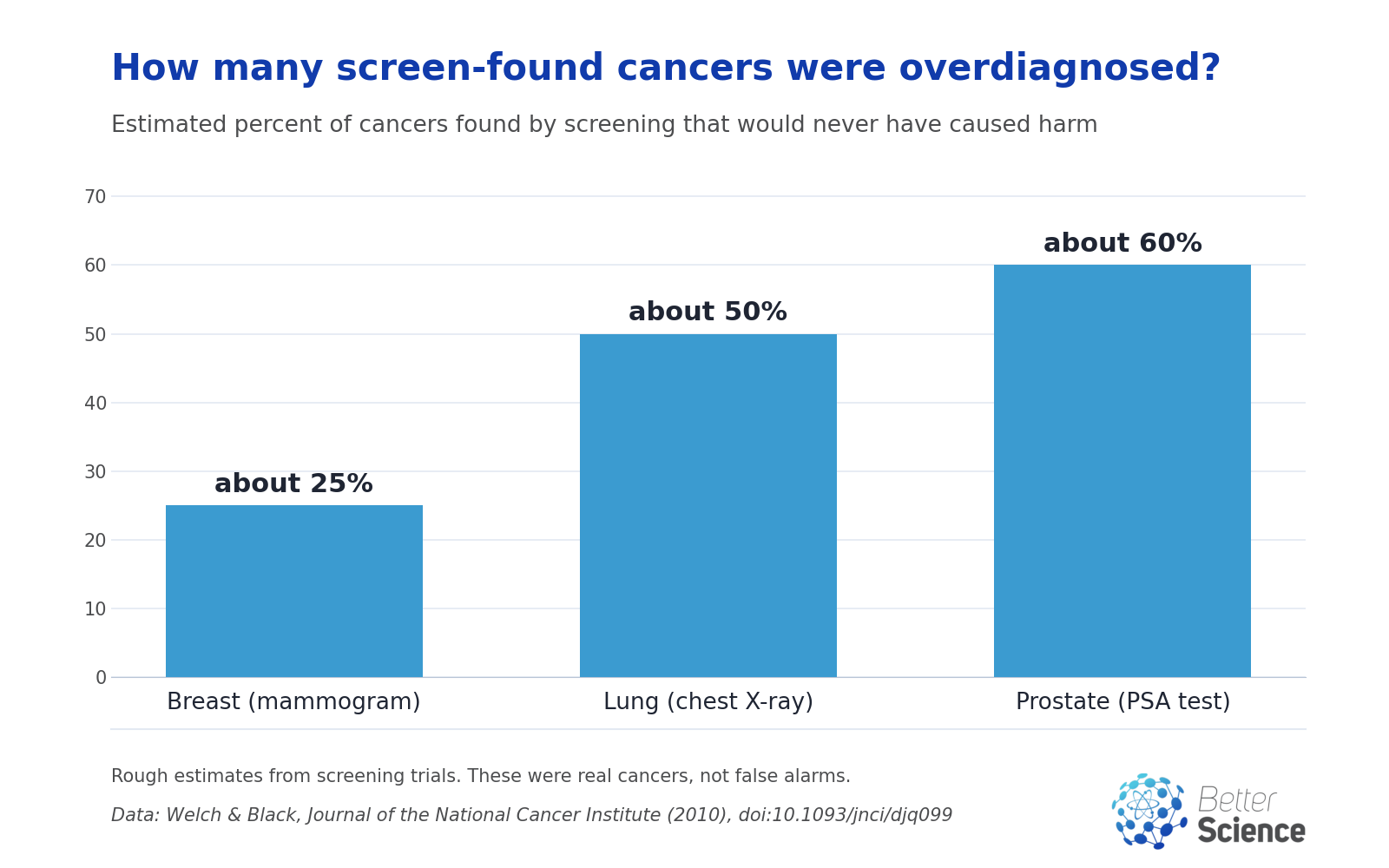
Chart by Better Science from data in Welch and Black, Journal of the National Cancer Institute (2010), doi:10.1093/jnci/djq099.
Numbers for whole countries point the same way. When diagnoses rise fast but deaths stay flat, overdiagnosis is the likely reason. US thyroid cancer diagnoses more than doubled from 1975 to 2005, while deaths held steady.
South Korea, where thyroid screening became widespread, shows an extreme case. The rate of thyroid cancer diagnoses in 2011 was 15 times the 1993 rate [2]. Yet thyroid cancer deaths stayed stable. The authors of that report wrote that this pattern suggests overdiagnosis caused by widespread screening.
Why can survival rates rise without saving lives?
Many people judge screening by survival rates, such as the share of patients alive five years after diagnosis. A plain-language explainer from the National Cancer Institute (NCI) explains why that can mislead [3].
The first problem is called lead-time bias. Screening moves the date of diagnosis earlier, but that does not always change the date of death. In a made-up NCI example, a man with a cough is diagnosed with lung cancer at 67 and dies at 70. Five-year survival for patients like him is 0%. If screening had found the same cancer at 60, and he still died at 70, five-year survival for patients like him would be 100%. In the NCI’s words, “the man does not live even a second longer.”
Overdiagnosis can push survival rates up even more. The NCI’s example imagines 1,000 people whose cancers were found because of symptoms, with 40% alive after five years. Add 2,000 overdiagnosed people, who all survive because their cancers were harmless. Five-year survival jumps to 80%, yet “exactly the same number of people died.”
This fools doctors too. In a survey the NCI describes, about 3 in 4 primary care doctors wrongly believed that better survival shows a test saves lives. The reliable test is a fair trial in which the screened group has fewer cancer deaths than the unscreened group.
So should people skip screening?
No, that would be the wrong lesson.
The NCI notes that trials have shown that screening saves lives for several common cancers, including cervical, colorectal, lung and breast cancer. Welch and Black describe a large European prostate trial in which PSA screening was linked to a 20% lower rate of prostate cancer deaths. That is a relative drop, not 20 fewer deaths per 100 men. The same trial also found about 34 extra prostate cancers for every 1,000 men screened, and many of those may have been overdiagnosed. Welch and Black found little sign of overdiagnosis from cervical and colorectal screening, where new diagnoses have been falling.
The NCI also stresses that many cancers found by screening do need treatment.
The real question is whether the benefits outweigh the harms. Welch and Black drafted a simple example for mammograms. Picture 1,000 women aged 50 who have a mammogram every year for 10 years. By their estimate, 1 woman would avoid dying of breast cancer. Between 2 and 10 would be overdiagnosed and treated for no benefit. Between 200 and 500 would have at least one false alarm.
Those numbers are uncertain. In Malmö, about 2 women were overdiagnosed for every breast cancer death avoided. Other researchers have argued the ratio is closer to 1 to 10. The authors write that there is no right answer to this trade-off. Different people, even in the same situation, can reasonably choose differently.
Does this prove screening does more harm than good?
It does not. The evidence shows that overdiagnosis is real and can be large for some cancers. It does not show that screening is harmful overall. The balance depends on the cancer, the test, and the person’s age, health and values.
The estimates should also be read with caution. Welch and Black admit that measuring overdiagnosis is hard, because few screening trials follow people for long. One of their examples, chest X-ray screening for lung cancer, is an older test. The NCI notes that earlier studies found it does not reduce lung cancer deaths.
There are ways to shrink the problem. The authors suggested testing ideas such as ignoring very small findings, or waiting to see if a spot grows before doing a biopsy. That wait-and-watch approach was already accepted for small spots on lung CT scans. Genetic tests might one day predict which cancers are dangerous, but in 2010 they could not.
I think overdiagnosis is one of the most important ideas in medicine that most people have never heard of. It does not mean screening is bad. It means that finding cancer early is not automatically the same as saving a life, and people deserve to hear both sides before they decide.
Welch and Black also describe what some call the popularity paradox of screening. The more people are overdiagnosed and treated, the more people believe screening saved their life. That makes screening more popular, whatever its real benefit.
Bottom line
A screening test can find a real cancer and still do harm, if that cancer would never have caused a problem. No one can tell which person that happened to, so some people get treatment they did not need. Rising survival rates can hide this, because they can climb without any lives being saved.
That does not make screening a mistake. For some cancers, fair trials show that screening prevents deaths. The balance of benefit and harm depends on the cancer and on you. If you are deciding about a screening test, talk with your doctor. Ask how often it saves lives for people like you, and how often it leads to overdiagnosis. A related post covers how screening could be matched to each person’s risk.
References
[1] H. G. Welch and W. C. Black, “Overdiagnosis in cancer,” Journal of the National Cancer Institute, vol. 102, no. 9, pp. 605-613, May 2010, doi: 10.1093/jnci/djq099.
[2] H. S. Ahn, H. J. Kim, and H. G. Welch, “Korea’s thyroid-cancer ‘epidemic’: screening and overdiagnosis,” New England Journal of Medicine, vol. 371, no. 19, pp. 1765-1767, Nov. 2014, doi: 10.1056/NEJMp1409841.
[3] National Cancer Institute, “Crunching numbers: what cancer screening statistics really tell us,” cancer.gov, May 1, 2012 (updated Jul. 16, 2018). [Online]. Available: https://www.cancer.gov/about-cancer/screening/research/what-screening-statistics-mean
Related Articles