Most medicines are made for thousands of people. In 2025, a team in Philadelphia made one for a single baby. Could that become a normal way to treat rare genetic diseases?
The baby, known publicly as KJ, was born with a rare liver disease. His body could not clear ammonia, a waste product that builds up when we digest protein. The team wrote a gene-editing drug to fix one of the spelling errors behind his disease. They built it, tested it and got permission to use it in about six months [1].
In the weeks after treatment, KJ could eat more protein, needed less medicine, and got through several viral illnesses without an ammonia crisis. However, the published report covers only one child followed for seven weeks. He was also getting other treatments at the same time, and no one yet knows how long the effect will last.
What was wrong with KJ?
KJ has a condition called CPS1 deficiency. CPS1 is a liver enzyme the body needs to turn ammonia into urea, which then leaves the body in urine. Without it, ammonia rises to toxic levels and can damage the brain [2]. The severe form is very rare, about 1 in 1.3 million births. About half of babies with it die in early infancy.
Within two days of birth, KJ was sluggish and struggling to breathe. His blood ammonia was over 1,000 units, while the normal range is 9 to 33. Doctors put him on a blood-filtering machine to pull the ammonia down. They then kept him on a protein-restricted diet and a daily medicine that helps control ammonia, called a nitrogen scavenger.
The usual long-term answer is a liver transplant. But babies need to grow before they can safely have one, and each ammonia spike risks lasting brain damage. KJ was put on the transplant list at 5 months of age, even though transplant is risky at that age.
How does base editing fix one letter?
Think of your DNA as a very long instruction book written in four letters. KJ’s book had two typos in the CPS1 gene. Each one turned a normal instruction into an early stop sign, so his liver could not make a full, working enzyme.
Older gene-editing tools work like scissors. They cut the DNA and let the cell patch it up, which can leave messy results. The tool used here, called a base editor, works more like a pencil and eraser. It finds the exact spot and chemically changes one letter into another, without cutting through both strands of the DNA.
The kind used for KJ, called an adenine base editor, changes the letter A into a G. Scientists first described this kind of editor in 2017 [3]. In human cells, those early versions made the intended change about half the time, with very few unwanted extra or missing letters. KJ’s team used a newer version, picked for his exact typo, so those 2017 numbers do not describe his drug.
To get the editor into KJ’s liver, the team packed its instructions into tiny fat bubbles called lipid nanoparticles. The drug was dripped into a vein and designed to reach liver cells. Fat bubbles can be given more than once, so the team could start low and add more later.
How did the team build a drug in six months?
KJ had two different typos in his CPS1 gene, one from each parent. The team aimed its editor at the typo he inherited from his father. The chart below shows roughly how the months went.
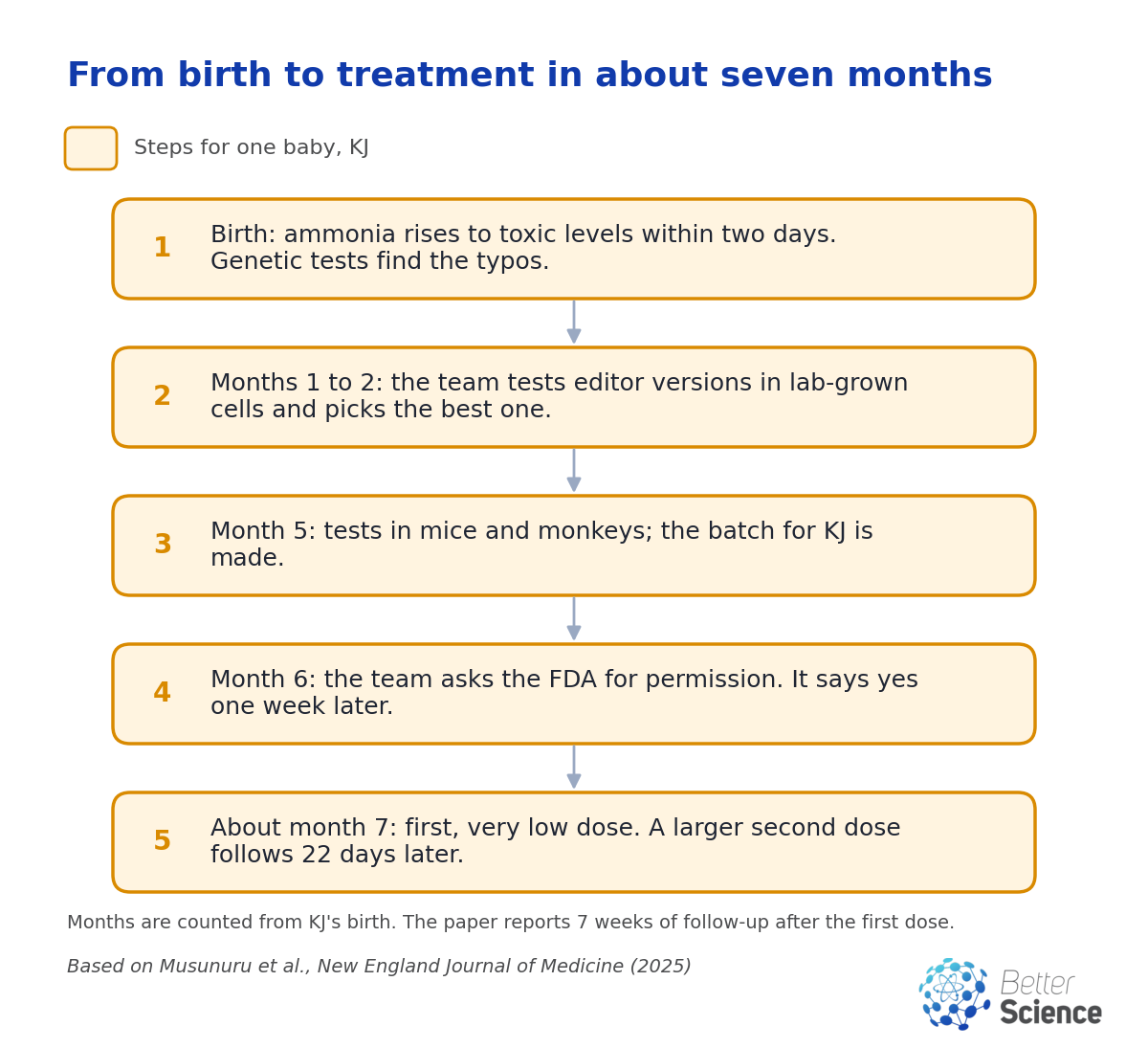
Diagram by Better Science based on Musunuru et al., New England Journal of Medicine (2025), doi:10.1056/NEJMoa2504747.
In the first months, the team tested many editor versions in lab-grown human liver cells that carried KJ’s typo. By two months after his birth, they had chosen the best one. They also built mice that carried the same stretch of human DNA. In those mice, the drug fixed the typo in up to 42% of the targeted DNA copies in the liver.
Safety checks came next. The team gave the drug to monkeys to look for harm. They also checked where in the DNA the editor might change the wrong letter. They found only a small change at one site, in one kind of lab-grown cell. That change did not appear in real human liver cells.
When KJ was 6 months old, the team asked the U.S. Food and Drug Administration (FDA) for permission to treat him. The FDA said yes one week later.
What changed after the treatment?
KJ got his first infusion on day 208 of his life, at a very low dose. His doctors let him eat more protein. But when they tried to lower his nitrogen medicine, a warning sign in his blood called glutamine rose. So they returned him to the full dose.
Because the first dose did not fully correct his blood chemistry, he got a second, three times larger dose 22 days later. Two weeks after that, he was able to take half his usual dose of the nitrogen medicine.
The clearest sign of change came when he caught ordinary childhood viruses. After the second dose, he caught two viruses with vomiting and diarrhea. The team compared this with a stomach virus he had before treatment. This time he recovered without an ammonia crisis and kept eating his full protein diet.
The only side effect the paper reports was a coughing spell during the second infusion. His liver tests rose for a short time after the second dose and again during a later virus. His weight went from the 9th percentile to the 26th. That means he went from being lighter than about 91 of 100 babies his age to lighter than about 74 of 100.
Can one child prove that the drug works?
One child cannot prove it alone. This was a single patient, with no comparison group. The paper’s main follow-up covers only seven weeks after the first dose.
It is also hard to separate the drug’s effect from everything else going on, including his other treatments. KJ stayed on a special diet, citrulline supplements and nitrogen medicine. He was also given two drugs that calm the immune system, in case his body attacked the newly made enzyme. His disease had also shifted on its own before. He had a calmer stretch from about day 50 to day 100 of life, then got worse. With ups and downs like that, it is hard to tell what caused a change in one child.
The team could not directly check how many of KJ’s liver cells were edited. Taking a piece of his liver was judged too risky for an infant. They also could not test whether the editor reached egg or sperm cells. A study of a different fat-bubble editing drug in animals found no sign of that.
So the evidence comes from comparing one child before and after treatment. It suggests the drug helped. But it is not as strong as a larger trial with a comparison group. The authors say so themselves: “longer follow-up is needed to assess the safety and efficacy” of the drug.
What has happened since?
KJ received a third dose in April 2025, according to the hospital announcements. That dose is not described in the paper. A year after his first dose, the hospital reported that he was walking and talking [4]. One of his lead doctors added a careful note: “this treatment isn’t a cure,” and he will be watched closely for long-term effects.
Cost is another open question. The paper does not report what the drug cost to make. Four companies made in-kind contributions, such as donated materials or services. It is unclear what a repeatable process would cost a hospital or a family.
Imagine a key-cutting shop. Each customer’s key is different, but the machine, the blank metal and the checks are the same. If the shop proves the machine works well, it should not need a year of testing for every new key. That is the idea behind treating many custom editors as one product.
In February 2026, the FDA released draft guidance for what it calls a Plausible Mechanism Framework [5]. It says that editing drugs aimed at different typos in one gene could be reviewed in a single application. They might also be tested in a single trial. It is a draft, which means the FDA asked for public comments before settling on a final version. The FDA also noted that trials will be small, so results must be strong enough to rule out chance.
Researchers from KJ’s team have already reported early lab work toward this kind of trial [6]. It uses a related tool called prime editing. They also met with the FDA about one trial that could include children with any of seven urea cycle disorders. That is the family of diseases that includes KJ’s.
Is building drugs for one person worth it?
A fair objection is that custom drugs could drain money and expert time that might help more people. There is also a safety worry. If every patient gets a slightly different drug, each one has had less testing.
The strongest answer is the idea of a shared platform, meaning one basic drug design reused for many patients. The fat bubble and the editor’s instructions could stay the same from patient to patient. Only the short address label that points the editor to the right typo would change. The authors suggest that future cases might not need new animal studies at all. They argue that this approach could work for hundreds of inherited liver diseases.
I think KJ’s case is a real first, reported with honest limits. My concern is that a drug that helped one child is still far from a platform approved for many. Faster review matters for very sick children. But if each patient’s drug gets fewer tests, every treated child should be followed for years, and the results should be shared openly.
Families facing a rare genetic disease should talk with their child’s specialist about what options exist. This case does not mean a custom editing drug is available to most patients today.
Bottom line
A team built and gave a personalized gene-editing drug to one baby in about six months. In the weeks that followed, he tolerated more protein, needed less medicine and got through viral illnesses without an ammonia crisis. That is a meaningful result for a disease that kills about half of affected babies.
Still, this is one child, a short follow-up and several other treatments at once. We do not yet know how safe or lasting the fix is, or how well it will work for others. The next test is whether the same approach holds up in small trials across many children.
References
[1] K. Musunuru, S. A. Grandinette, X. Wang, T. R. Hudson, K. Briseno, A. M. Berry, et al., “Patient-Specific In Vivo Gene Editing to Treat a Rare Genetic Disease,” New England Journal of Medicine, vol. 392, no. 22, pp. 2235-2243, 2025 (published online May 15, 2025), doi: 10.1056/NEJMoa2504747.
[2] Penn Medicine, “World’s first patient treated with personalized CRISPR gene editing therapy at Children’s Hospital of Philadelphia,” press release, May 15, 2025. [Online]. Available: https://www.pennmedicine.org/news/worlds-first-patient-treated-with-personalized-crispr-therapy
[3] N. M. Gaudelli, A. C. Komor, H. A. Rees, M. S. Packer, A. H. Badran, D. I. Bryson, and D. R. Liu, “Programmable base editing of A•T to G•C in genomic DNA without DNA cleavage,” Nature, vol. 551, no. 7681, pp. 464-471, Nov. 2017, doi: 10.1038/nature24644.
[4] Children’s Hospital of Philadelphia, “Children’s Hospital of Philadelphia Marks One-Year Anniversary of World’s First Personalized CRISPR Gene Therapy for Child with Rare Genetic Disease,” press release (PR Newswire), Feb. 25, 2026. [Online]. Available: https://www.prnewswire.com/news-releases/childrens-hospital-of-philadelphia-marks-one-year-anniversary-of-worlds-first-personalized-crispr-gene-therapy-for-child-with-rare-genetic-disease-302696376.html
[5] U.S. Food and Drug Administration, “FDA Launches Framework for Accelerating Development of Individualized Therapies for Ultra-Rare Diseases,” press announcement, Feb. 23, 2026. [Online]. Available: https://www.fda.gov/news-events/press-announcements/fda-launches-framework-accelerating-development-individualized-therapies-ultra-rare-diseases
[6] E. R. Feierman, M. N. Whittaker, A. Quigley, D. L. Brooks, P. McVeigh, A. X. Nan, et al., “Implications of the FDA’s new plausible mechanism framework for the development of a personalized in vivo prime editing platform,” American Journal of Human Genetics, vol. 113, no. 5, pp. 891-899, May 2026, doi: 10.1016/j.ajhg.2026.03.018.
Related Articles