In December 2022, the journal Communications Medicine published a large test of a human Liver-Chip [1]. This is a small device lined with living human liver cells. The team ran 870 chips against 27 drugs with known effects on the liver. The drugs were blinded, meaning the testers did not know which drug was which.
The chip caught 87% of the harmful drugs, close to 9 in 10. It flagged none of the safe ones as harmful. The same month, the United States changed the law so that drug makers could lean on tests like this one.
This topic is often framed as a simple question: can chips replace animal testing? I think a better question is what specific task a model has been validated for. In my view, a model should earn trust one clearly defined task at a time, and this study is a good example of that.
What was the Liver-Chip asked to do?
The task was narrow on purpose. The chip had to predict drug-induced liver injury (DILI), which is liver damage caused by a medicine [1]. The team used test drugs and guidelines from the Innovation and Quality (IQ) consortium. That is a group of drug and biotech companies. The authors framed their work as testing the chip “within the context of use of DILI prediction”. This phrase means the chip was tested for one specific job only.
They also made a broader point about lab models. Some features make a lab model look realistic. Too often, they wrote, those features are “chosen post hoc by the authors and not prospectively by an independent third party”. In other words, the people who build the model choose those features after the work is done. A fixed test chosen by an outside group avoids that problem.
Sensibly, the team kept separate groups for preparing, dosing and analyzing. So the people dosing the chips or studying the results did not know which drug they were handling. The team chose eight of the test drugs because they had harmed patients’ livers even after passing standard safety tests in animals.
Imagine a smoke detector advertised as better than a fire inspector. It may well catch more kitchen fires. It still cannot tell you whether the wiring in the walls is safe, because nobody tested it for that job.
I read a number like 87% the same way. It applies only to the task that was tested. Here, that task was spotting liver damage from known small-molecule drugs, which are ordinary chemical medicines rather than large biological drugs.
What do the numbers really show?
Two terms help here. Sensitivity is the share of harmful drugs a test catches. Specificity is the share of safe drugs it correctly calls safe.
In the first analysis, the chip caught 12 of 15 toxic drugs, a sensitivity of 80% [1]. The team compared this with 3D spheroids, which are small balls of liver cells grown in a dish. Based on earlier published data, the spheroids had a sensitivity of 42%. The chip wrongly flagged no safe drug. The spheroids had a specificity of 67%, about 2 in 3.
The headline 87% came from a second analysis. It took into account how much of each drug sticks to proteins, both in the chip’s fluid and in patients’ blood. The authors set the cutoff at a value they “selected to maximize sensitivity while avoiding false positives”. They also used cells from two donors.
I think that is reasonable. But the team picked the cutoff using the same drugs that were then used to score the chip. I would want to see it hold up on new drugs before treating 87% as the chip’s true rate.
The study also had gaps. The chip did not catch liver damage from zileuton, an asthma drug. One test drug, pemoline, was left out. Its liver damage is thought to involve the immune system, which would need a more complex chip.
Chips, organoids and animals are different tools
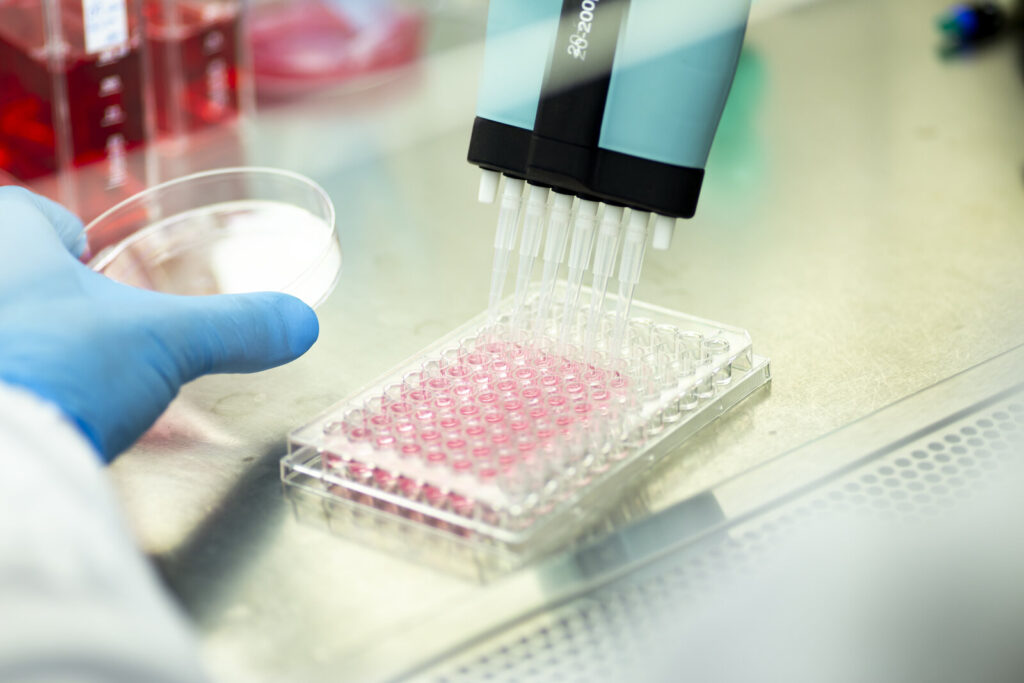
People often treat these three as if they were the same. An organ-on-a-chip is a small device with tiny channels [2]. Cells grow inside it while fluid flows past them all the time. The Liver-Chip has two channels split by a thin membrane full of tiny holes [1]. Liver cells sit on one side. On the other side are cells that line blood vessels, along with other kinds of liver cells.
Organoids are different. They grow from stem cells that arrange themselves into small, tissue-like shapes [2]. They are usually grown in still fluid, without flow. A 2022 review described the trade-off between them. Chips offer control over the cells’ surroundings “but are commonly simplistic models of the target organ”. Organoids are closer to how real tissue forms, but they vary more.
A whole animal is a third, different kind of model. It has many organs, a blood supply and an immune system, all working at once. Each of these three is a model, and none of them is a human patient.
Who ran the study, and what did the corrections change?
The paper is open about who did the work. Of the 32 authors, 28 are declared as current or former employees of Emulate [1]. That is the company that makes the chip, and these authors may hold equity, meaning an ownership stake, in it.
Donald Ingber of Harvard’s Wyss Institute is declared as a founder of Emulate. He is also a board member, the chair of its scientific advisory board and an equity holder in it. Jack Scannell is a shareholder and director of JW Scannell Analytics. He received payment from Emulate for his part in the work. Two authors, from Janssen and AbbVie, declared no competing interests. The authors also say two outside toxicologists, experts in poisons and drug harm, independently checked the data.
I mention this as background, and I am not accusing anyone of wrongdoing. Companies should test their own products. But a test led by the maker is a first step. The next step would be independent labs repeating it on new drugs.
Two author corrections followed in early 2023. The first fixed a table where the spheroid specificity read 100% instead of 67% [3]. It also fixed a typo in the summary. The second replaced a table that had copied another table’s data [4]. According to the correction notices, neither correction changed the chip’s 87% and 100% figures in the summary and text [1]. The first correction just made the table match the 67% that was already in the text.
What do animals still capture, and why does the chip still matter?
The strongest case for animal tests is that an animal has a whole body. A drug can be broken down in one organ and harm another. The paper’s own authors suggest the drugs their chip missed may involve “other cells or tissues not present in these models” [1]. They only tested small-molecule drugs. They call for testing larger biological drugs next.
A review from the same year lists challenges that organoids still face [2]. One is copying how the whole body works, including how organs affect each other. The review sees combining organoids with chips as one way forward.
My earlier work included modeling PET/CT scans, a type of medical imaging, to track how a substance moves through a whole living body over time. From that experience, I see a single-organ chip as answering a narrower question than an animal does, but answering it more clearly.
Still, I think the result is promising. Every toxic drug in the test had already been checked in animals [1]. Each had been judged safe enough for human trials. The chip flagged most of them.
Some supporters go further. Ingber, an Emulate founder, has called the failure of animal models to predict human responses a major problem [5]. He wrote that using chips instead of animals is “ever closer to realization”. The Liver-Chip paper itself suggests a smaller role [1]. It would place the chip after early tests on cells and before the animal studies that help choose doses. There, it could screen out risky drugs and reduce animal use.
Recent law also moves in this direction. The FDA Modernization Act 2.0 passed the Senate in September 2022. It aimed to allow other options, such as tests on cells and computer models. Its changes became law on December 29, 2022, inside a large spending act. That act replaced the phrase “preclinical tests (including tests on animals)” with “nonclinical tests.” That new term clearly includes organ chips, computer modeling and, still, animal tests.
Validated for what?
For some decisions, chips may replace animal tests once a chip has been proven for that decision. For other decisions, they cannot replace animals yet. Now that the law allows a choice, it is even more important to know what each model has been shown to predict.
In my view, saying a chip will replace animal testing is a broad promise, and it is not evidence. Evidence is a clear result for one job, such as spotting liver injury from small-molecule drugs, with the known misses listed. I would hold every model, chip or animal, to that standard.
When you read about a new lab model, look for three things. They are the exact task, the set of test drugs and who chose the cutoff. The Liver-Chip study answered all three openly, which is why it deserves attention. The next step is independent groups testing it on drugs it has never seen.
References
[1] L. Ewart, A. Apostolou, S. A. Briggs, C. V. Carman, J. T. Chaff, A. R. Heng, et al., “Performance assessment and economic analysis of a human Liver-Chip for predictive toxicology,” Communications Medicine, vol. 2, no. 1, Art. no. 154, Dec. 2022, doi: 10.1038/s43856-022-00209-1.
[2] L. S. Baptista, C. Porrini, G. S. Kronemberger, D. J. Kelly, and C. M. Perrault, “3D organ-on-a-chip: The convergence of microphysiological systems and organoids,” Frontiers in Cell and Developmental Biology, vol. 10, Art. no. 1043117, Nov. 2022, doi: 10.3389/fcell.2022.1043117.
[3] L. Ewart, A. Apostolou, S. A. Briggs, C. V. Carman, J. T. Chaff, A. R. Heng, et al., “Author Correction: Performance assessment and economic analysis of a human Liver-Chip for predictive toxicology,” Communications Medicine, vol. 3, no. 1, Art. no. 7, Jan. 2023, doi: 10.1038/s43856-023-00235-7.
[4] L. Ewart, A. Apostolou, S. A. Briggs, C. V. Carman, J. T. Chaff, A. R. Heng, et al., “Author Correction: Performance assessment and economic analysis of a human Liver-Chip for predictive toxicology,” Communications Medicine, vol. 3, no. 1, Art. no. 16, Feb. 2023, doi: 10.1038/s43856-023-00249-1.
[5] D. E. Ingber, “Human organs-on-chips for disease modelling, drug development and personalized medicine,” Nature Reviews Genetics, vol. 23, no. 8, pp. 467-491, Aug. 2022, doi: 10.1038/s41576-022-00466-9.
Related Articles