A woman with breast cancer had already tried radiation, chemotherapy and other standard treatments. The researchers who later told her story call her Jane [1]. Her alternative medicine practitioner shared an article about a treatment that used vitamin infusions. To her and her practitioner, it seemed to offer real hope.
Then Jane showed the article to her son-in-law, one of the researchers who later wrote about her case. He saw that it came from a predatory journal. That meant no qualified expert had likely checked whether its claims held up.
A predatory journal looks like a science journal but skips the work that makes a journal worth trusting. It charges authors a fee and publishes their papers without the expert checks it promises. Studies suggest these journals publish a large number of papers, but it is not always easy to tell a weak journal from a predatory one.
What is a predatory journal?
When scientists send a paper to a journal, the editor asks other experts in the field to look for mistakes. This is called peer review.
Open-access journals let anyone read their papers for free. Many cover their costs by charging authors a fee instead of charging readers. This way of paying for publishing is honest and widely used.
Predatory journals copy this way of paying but skip the expert checks. In 2019, a group of 43 people from 10 countries met in Ottawa, Canada, to agree on a definition [1]. They included researchers, publishers, funders, librarians and patients. They agreed that predatory journals “prioritize self-interest at the expense of scholarship.”
The group named four signs: false or misleading information, poor publishing practices, a lack of openness, and aggressive, repeated requests for papers.
How do these journals fool people?
Predatory journals often show fake impact factors, which are scores meant to show how often a journal’s papers are cited. They also give false addresses and false claims about which databases list them. Some name editors who cannot be found or checked.
Many do not clearly list their fees or contact details. They also send flattering emails that say a paper is urgently needed for the next issue. The 2019 group said one sign is especially clear. It is an invitation to publish from a journal outside the scientist’s own field.
A 2013 investigation in the journal Science showed how this works [2]. A biologist in Nigeria named Aline Noutcha sent a paper to a journal whose publisher’s website did not mention fees. After the paper was accepted, she was asked to pay $150. She did not have a credit card, so a friend in the United States finally paid a reduced fee for her.
The journalist, John Bohannon, looked into that publisher. Its website placed one of its journals in Los Angeles, but the street address appeared to be the meeting point of two highways. When he later sent it a paper of his own, the invoice asked for $200 to be sent to a bank in Hong Kong.
Will these journals publish anything?
Bohannon wrote a fake paper, with made-up authors, claiming that a chemical from a lichen slowed the growth of cancer cells. He built in errors that any trained reviewer should catch.
The chemical was given to cells in a liquid. The cells it was compared with did not get that same liquid. That liquid contained a lot of alcohol, which alone harms cells. So the results showed nothing about the chemical. The paper even ended by calling the chemical a promising new cancer drug.
Between January and August 2013, he sent versions of this paper to 304 open-access journals. By the time Science printed the story, 157 journals had accepted it and 98 had rejected it. Only 36 of the 304 submissions got reviewer comments that noticed any of the science problems. Even so, 16 of those 36 papers were accepted anyway.
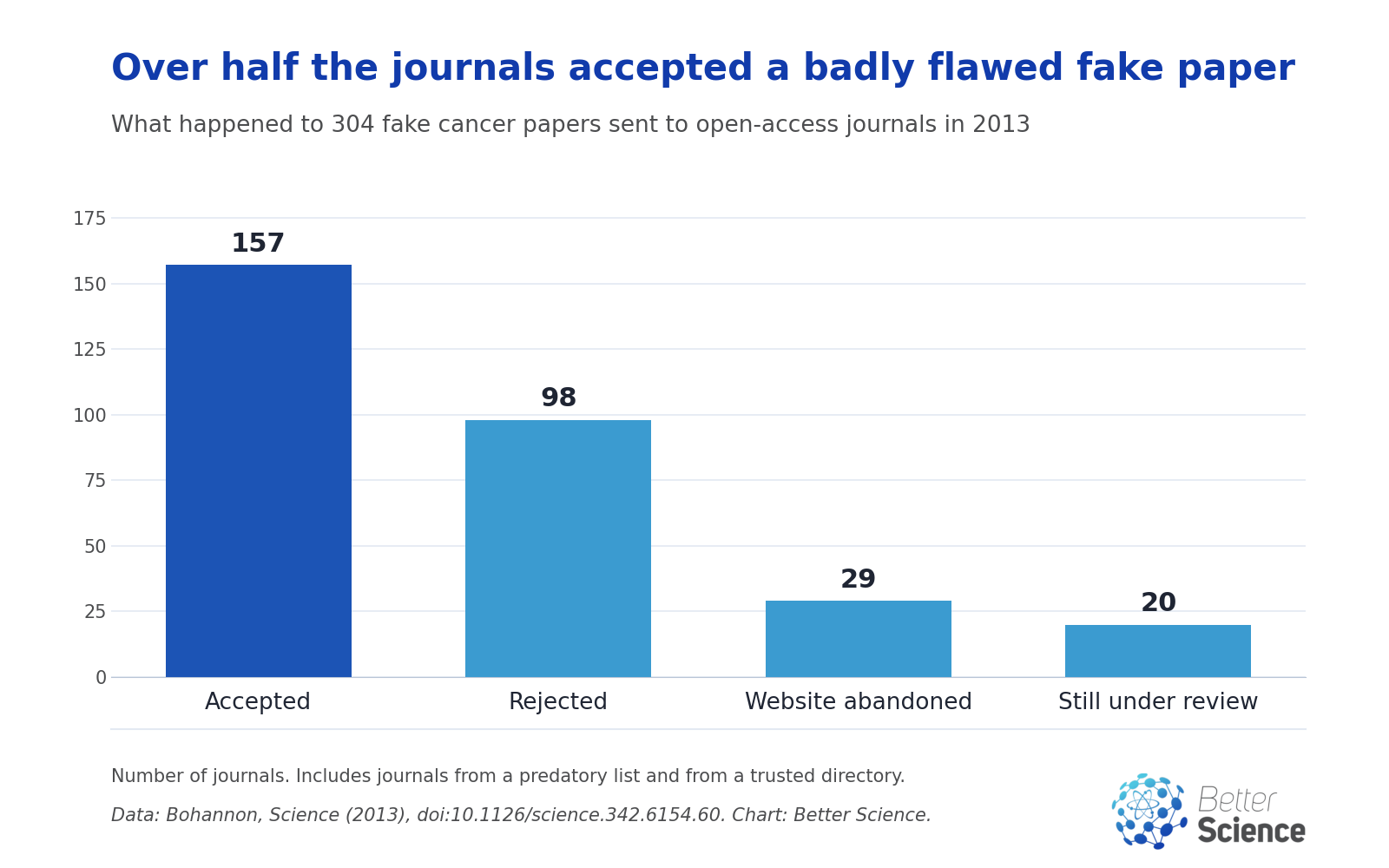
Chart by Better Science from data in Bohannon, Science (2013), doi:10.1126/science.342.6154.60.
Bohannon picked his targets from two lists. One was the Directory of Open Access Journals, or DOAJ, which aims to include trusted open-access journals. The other was a list of likely predatory publishers kept by Jeffrey Beall, a university librarian in Colorado. His final list held 304 publishers: 167 from the directory, 121 from Beall’s list and 16 on both. He sent the paper to one journal from each.
Among publishers from Beall’s list that made a decision, 82% accepted the paper. Among DOAJ publishers, 45% accepted it, a little under half. So a listing in the directory did not guarantee careful review at that time.

How big is the problem?
Two researchers in Finland, Cenyu Shen and Bo-Christer Björk, tried to measure how big the problem is [3]. Starting from Beall’s lists in September 2014, they found 11,873 journals and studied a sample of 613 by hand.
They estimated that about 8,000 of these journals were active in 2014, up from about 1,800 in 2010. They also estimated that the journals published about 53,000 articles in 2010 and about 420,000 in 2014. By my own math, that is about 8 times as many in four years.
These are rough estimates, as the authors themselves warned, because their sampling method was complex. They also noted that Beall’s list, their starting point, is “highly controversial.”
Fees were low, about $178 per article on average. Most authors came from Asia and Africa, and about 35% were from India.
Is this only a problem in poorer countries?
A 2017 study by David Moher and colleagues in Ottawa found that it is not [4]. They studied 1,907 medical and biology papers from more than 200 likely predatory journals. More than half of the papers’ contact authors, the scientists in charge of each paper, were from high-income or upper-middle-income countries. The United States produced more papers in their sample than any country except India.
The papers were also poorly reported. Only 40% of the studies on people or whole animals said an ethics committee had approved them. Earlier studies found that mainstream journals mention this approval far more often, about 70% of the time for human studies.
Why should people outside science care?
Jane’s story shows the first reason. A paper in a predatory journal looks like any other paper. Anyone can find it, share it or quote it in the news, and most readers cannot tell that no expert checked it.
Wasted research is another cost. Moher’s team found that their sample held data from more than 2 million people and more than 8,000 animals. Much of that work was reported too poorly to repeat and is hard to find. The team wrote that little of it will advance science. The team called publishing in predatory journals “unethical” for this reason.
The harm also falls on researchers, including many who are new to publishing. Moher’s article also describes an earlier study by researchers in Indiana. It looked at seven predatory journals about drug research. In that study, 65% of authors had never published a paper before, compared with 19% in vetted open-access journals. Shen and Björk add that some universities reward “international” papers without checking the journals. Authors in lower-income countries may also pay the fees from their own pockets.
Is open access the problem?
No. Open access is a way of paying for publishing, and many excellent journals use it. Shen and Björk wrote that predatory publishers cause “unfounded negative publicity” for open access in general. In Bohannon’s test, the large open-access journal PLOS ONE rejected the paper after a careful check, including questions about ethics.
Bohannon sent the fake paper only to open-access journals. So his test says nothing about how subscription journals would have done.
Some journals are not predatory, just poorly run. The 2019 group left “intent to deceive” out of its definition on purpose. They wrote that it can be hard to tell a predatory journal from one that simply lacks money and staff. A new journal must also publish for at least a year before it can apply to the DOAJ.
Lists of bad journals have also been controversial. Critics said some of Beall’s standards, such as poor English, were unfair to publishers outside the United States. Moher’s team noted that his lists were taken offline in early 2017.
My view is that predatory journals are a real problem, and that the answer is more careful checking by researchers, employers and readers. Open access itself is not the problem. I would rather see people learn a few quick checks than rely on any single list.
Also, not every author who publishes in these journals is fooled. Shen and Björk believe many authors know what they are doing and take a “calculated risk” that no one will check. Part of the 2019 group made a similar point. They noted that some scholars knowingly pay these journals to add a line to their resumes.
How can you check a journal?
Think. Check. Submit. is a free checklist run by a group of publishing and library organizations, including the DOAJ [5]. Its 2023 version asks questions like these:
- Do you know the journal? Have you or your colleagues read articles in it before?
- Can you reach the publisher? Look for a clear name, phone number, email and mailing address.
- Is the review process clear? Be wary if the journal promises acceptance or a very short review time.
- Are the fees clear? The site should say what they are and when they are charged.
- Is it in a trusted index? If the journal is open access, check whether the DOAJ lists it.
The checklist advises authors to submit only if they can answer “yes” to most or all of its questions. I would add one step: look up two or three of the listed editors on their own university pages. If those pages never mention the journal, be careful. Even a DOAJ listing is not a guarantee, as the 2019 group pointed out.
Readers who are not scientists can use a shorter version of these checks. When a news story cites a study, look at where it was published. If you do not know the journal, search for it in the DOAJ, and be extra careful with health claims.
Bottom line
Predatory journals charge for publishing but skip the checks that make a science journal worth trusting. They grew quickly in the 2010s and drew authors from rich and poor countries alike. Their papers can reach patients and reporters as if experts had reviewed them.
No list of predatory journals is complete or fully fair. It can also be hard to tell a weak journal from a deceptive one. A few plain questions about a journal’s editors, fees and review process are still the best protection we have.
References
[1] A. Grudniewicz, D. Moher, K. D. Cobey, G. L. Bryson, S. Cukier, K. Allen, et al., “Predatory journals: no definition, no defence,” Nature, vol. 576, no. 7786, pp. 210-212, Dec. 2019, doi: 10.1038/d41586-019-03759-y.
[2] J. Bohannon, “Who’s afraid of peer review?,” Science, vol. 342, no. 6154, pp. 60-65, Oct. 2013, doi: 10.1126/science.342.6154.60.
[3] C. Shen and B.-C. Björk, “’Predatory’ open access: a longitudinal study of article volumes and market characteristics,” BMC Medicine, vol. 13, Art. no. 230, Oct. 2015, doi: 10.1186/s12916-015-0469-2.
[4] D. Moher, L. Shamseer, K. D. Cobey, M. M. Lalu, J. Galipeau, M. T. Avey, et al., “Stop this waste of people, animals and money,” Nature, vol. 549, no. 7670, pp. 23-25, Sep. 2017, doi: 10.1038/549023a.
[5] Think. Check. Submit., “Journals” checklist, last updated Mar. 2023 with amendments in Jun. 2023. [Online]. Available: https://web.archive.org/web/20231114151310/https://thinkchecksubmit.org/journals/
Related Articles