

In June 2025, a team at the MIT Media Lab posted a preprint, a study shared online before other scientists have checked it. It was called “Your Brain on ChatGPT.” The team recorded brain activity from 54 adults as they wrote short essays [1]. Some used ChatGPT, some used Google, and some used no tools at all.
A week later, TIME’s headline read “ChatGPT May Be Eroding Critical Thinking Skills, According to a New MIT Study.”
I am an AI researcher. I build AI tools for medical data, so I use these systems in my own work.
My answer to the title question is no, at least not based on this study. It found that people who let AI write their essays remembered less of what they wrote and felt less ownership of it, which matters if the goal of writing is to learn something. In my view, though, this is what usually happens when a tool does part of a task for us, and it is not evidence of brain damage.
What did the MIT team do?
All the participants were 18 to 39 years old, and all came from universities around Boston [1]. The researchers randomly placed each person in one of three groups. One group used ChatGPT only, one used Google search with no AI, and the last group used no tools.
In each of three sessions, each person wrote an essay on an SAT-style prompt in 20 minutes. While they wrote, they wore an electrode cap that recorded brain activity, a method called electroencephalography, or EEG. Right after each essay, a researcher asked them to quote a sentence from it.
Two things keep me cautious. First, this is a small study. There were 18 people per group, and only 18 people in total came back for an optional fourth session. Second, it had not yet been checked by outside experts through peer review. The authors explain in their project FAQ that they released the preprint early to get feedback faster, with peer review only just started.
The EEG part got the headlines. It measured brain connectivity, which is how strongly activity at different spots on the scalp is linked. Connectivity was strongest with no tools, weaker with search, and weakest with ChatGPT. This result describes how brains were working during a 20-minute task with a tool in hand. It is not a scan of brain structure, and it says nothing about intelligence.
Why is the memory result the convincing part?
The finding I take seriously is much simpler. In the first session, 15 of the 18 ChatGPT users could not quote anything from the essay they had finished minutes earlier [1]. In each of the other two groups, only 2 of the 18 had that problem.
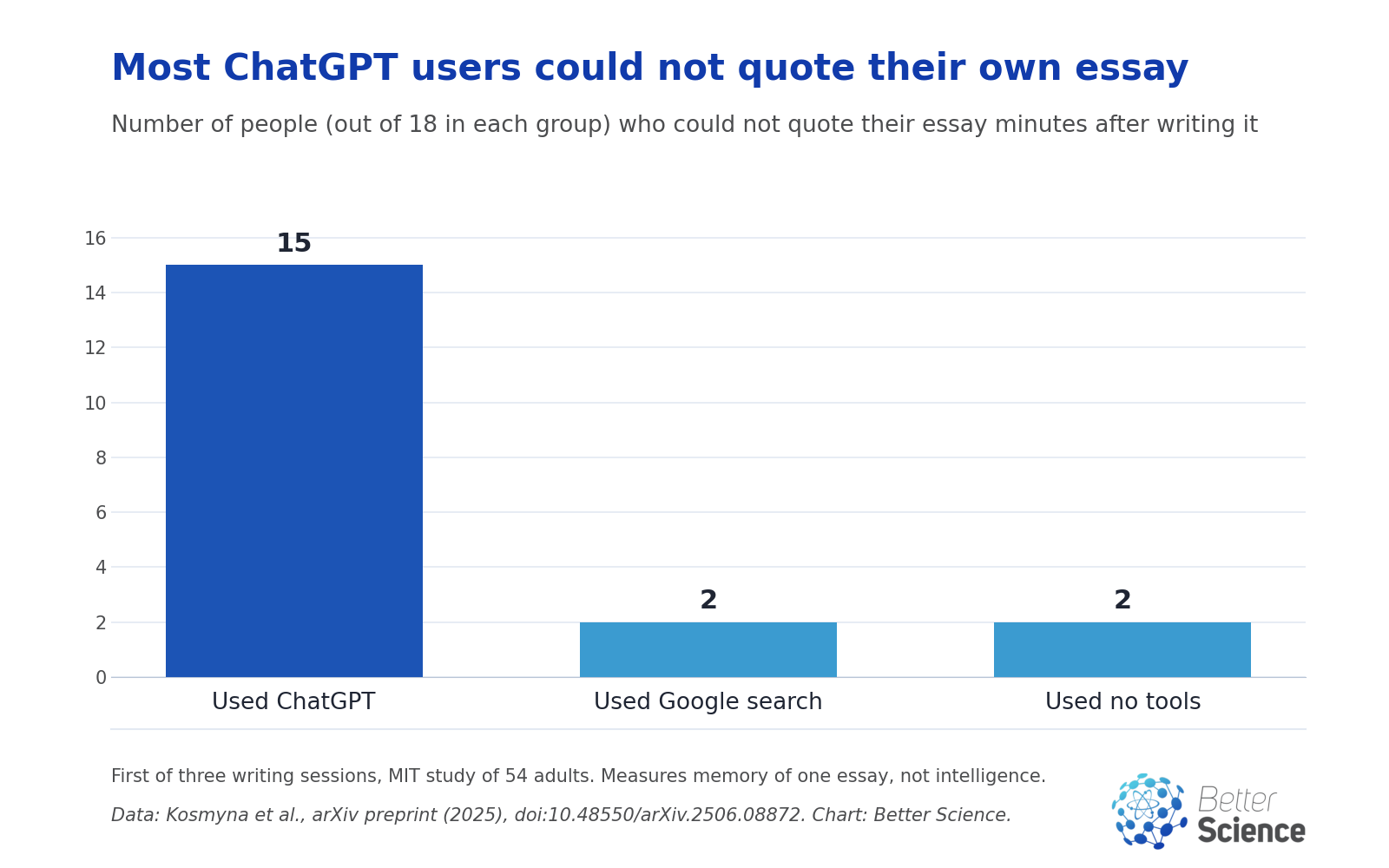
Chart by Better Science from data in Kosmyna et al., arXiv preprint (2025), doi:10.48550/arXiv.2506.08872.
When the researchers checked accuracy, none of the 18 ChatGPT users quoted their own essay correctly. In the other two groups, most people could.
Imagine two students writing the same essay. One drafts it herself. The other pastes in a chatbot’s version and tidies it up. An hour later, ask each of them to quote a line. The first can probably give you her opening sentence, while the second may struggle to recall what the essay argued.
The gap shrank in later sessions, once people knew the question was coming. But the ChatGPT group still did worst. They also felt less ownership. Only half called their first essay fully their own, while almost everyone in the no-tool group did. If you did not write the sentences, you never had to choose them or fix them, so there was little to remember.

Why does the search group change the story?
Most news stories skipped the search group, but for me it is the most telling part of the study. Search users also relied on an outside tool, and their brain connectivity was also well below the no-tool group [1]. Depending on the measure, it was roughly a third to a half lower. Yet they quoted their essays just as well as the people who used nothing. The difference is that search users still wrote their own sentences.
So simply using a tool did not hurt memory. Letting the tool write the sentences is what hurt it. Psychologists call this kind of trade cognitive offloading. It means using a physical action or an outside aid to ease the mental load of a task [2]. A phone reminder for an appointment is one example. We offload all the time, and it is usually sensible. The cost is easy to predict. If a tool does part of a task for you, you do not remember that part yourself.
Think about driving to a friend’s new house with turn-by-turn directions on your phone. You arrive without trouble, but if someone asked you to draw the route afterwards, you might not manage it. Nothing is wrong with your sense of direction. You simply never had to learn that route.
This is also why lower connectivity alone does not worry me. Search users showed it too, and they had no memory problem.
What did the headlines get wrong?
TIME’s headline was about critical thinking, but the study never tested critical thinking. It recorded EEG, studied the essays, and interviewed people about them [1]. Nobody was tested before and after months of AI use either, so the word “eroding” goes beyond what was measured.
The authors noticed. Their FAQ asks whether AI is making us “dumber,” and it answers with a plain no. It also asks people, and journalists in particular, to avoid certain words. These include “stupid,” “dumb,” “brain rot,” “harm” and “damage.” The reason, in the authors’ words: “It does a huge disservice to this work.”
To be fair, the alarm did not come only from reporters. The paper’s own abstract speaks of “a likely decrease in learning skills”. The lead author told TIME that “Developing brains are at the highest risk.” Yet every person in the study was an adult. So the risk to children is a worry worth studying, but the study did not test it.
What is the real cost, and what can we do?
I do not want to dismiss the study. Suppose the point of writing an essay is to learn. Then producing text you cannot recall or call your own is a real loss. The study also cannot rule out longer-term effects. It did not test them, which is why the authors call for longitudinal studies, meaning studies that follow people over a long time [1].
Other research points the same way. Researchers at Microsoft Research and Carnegie Mellon surveyed 319 knowledge workers, people whose jobs are mainly about handling information [3]. People with more confidence in generative AI, meaning tools like ChatGPT that create text or images, reported less critical thinking, while people with more confidence in themselves reported more. A survey like this can show that two things go together. It cannot show that one causes the other.
The workers also said AI shifted their critical thinking toward checking information and overseeing the task. That matches how I think about the models I build: their output is a draft to check, never an answer to trust.
My practical advice is my own inference, not something the study tested. If you are a student, write your own first draft. Then bring AI in to question it, tighten it or check it. You will remember the thinking you do yourself. If you teach, look at drafts and outlines, or ask students to explain their argument out loud.
AI is not making our brains dull, at least not on this evidence. What AI can do is let us skip the part of the work where we learn. Whether we skip that part is our choice.
So is AI making our brains dull? Not on this evidence. In this study, people remembered less of the writing they did not do themselves. That is just what we expect when we hand work to a tool. Decide which parts of the work you want to learn from, and do those parts yourself.
References
[1] N. Kosmyna, E. Hauptmann, Y. T. Yuan, J. Situ, X.-H. Liao, A. V. Beresnitzky, et al., “Your Brain on ChatGPT: Accumulation of Cognitive Debt when Using an AI Assistant for Essay Writing Task,” arXiv:2506.08872v1, Jun. 2025, doi: 10.48550/arXiv.2506.08872.
[2] E. F. Risko and S. J. Gilbert, “Cognitive Offloading,” Trends in Cognitive Sciences, vol. 20, no. 9, pp. 676-688, Sep. 2016, doi: 10.1016/j.tics.2016.07.002.
[3] H.-P. Lee, A. Sarkar, L. Tankelevitch, I. Drosos, S. Rintel, R. Banks, et al., “The Impact of Generative AI on Critical Thinking: Self-Reported Reductions in Cognitive Effort and Confidence Effects From a Survey of Knowledge Workers,” in Proc. 2025 CHI Conf. Human Factors in Computing Systems (CHI ’25), Yokohama, Japan, Apr. 2025, pp. 1-22, doi: 10.1145/3706598.3713778.
Related Articles