

AI may help a scientist publish more papers and earn more citations. But could it also push science toward the same familiar questions?
A study published in Nature in January 2026 looked for an answer [1]. Qianyue Hao, James Evans, and their team studied 41.3 million papers in the natural sciences. They used an AI system to identify papers that used AI as a research tool.
The career numbers were striking. Scientists who used AI published about three times as many papers. Their work received nearly five times as many citations. They also became research project leaders about 1.4 years sooner.
But there was a tradeoff. AI-based research covered a 4.63% smaller range of topics. Scientists doing this work also built on one another’s papers about 22% less often.
These results point to a tension. AI may help individual scientists move ahead while pulling science as a whole toward fewer topics. The study found a pattern, not proof that AI caused it.
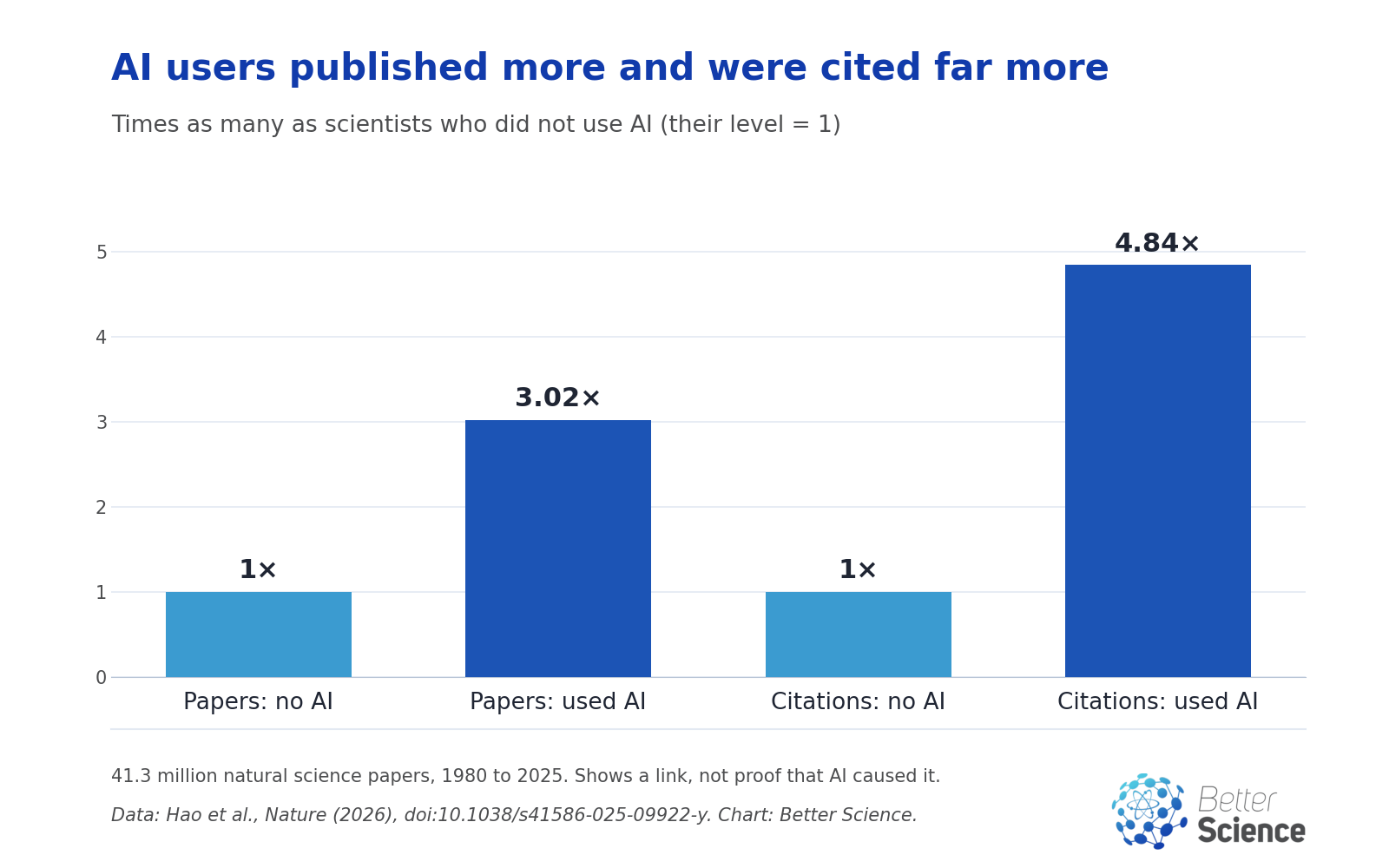
Chart by Better Science from data in Hao et al., Nature (2026), doi:10.1038/s41586-025-09922-y.
What Did the Study Measure?
The team studied papers published from 1980 to 2025 in six fields: biology, medicine, chemistry, physics, materials science, and geology [1]. It left out computer science and mathematics, where many AI methods are created. The goal was to study fields that use AI as a tool.
The researchers asked two main questions. First, did AI papers cover a wide range of topics? Second, did later scientists build on those papers?
To measure the range of topics, the team made a map from the words in each paper. Papers about similar ideas appeared close together. Papers about different ideas appeared farther apart. On this map, AI papers covered less ground. The same pattern appeared in all six fields.
The team also looked at how papers cited one another. AI papers gathered around a small number of popular studies. They were less likely to connect with other papers in the same group. The authors called these groups “lonely crowds.”
Why Does Available Data Matter?
AI needs examples to learn from. A scientist can start quickly when a question already has a large, clean dataset. A question with no ready-made data takes much longer because someone must first collect the information.
The study found that AI research moved toward topics with the most data. A topic’s funding level and earlier impact did not explain the pattern nearly as well [1].
This does not mean researchers choose easy questions on purpose. It means the tools themselves work best where plenty of data already exists. Over time, that advantage can draw more people toward the same areas.
Imagine two graduate students who start on the same day. One chooses a problem with a large public image dataset. That student can train a model and publish within a year. The other student chooses a question with no dataset. That student spends the year building equipment and collecting samples. The first student looks faster on paper, even if the second is exploring the newer question.
Why Can a Crowded Field Be a Problem?
The authors compare this pattern to people climbing a hill. Once researchers find a useful path, more people follow it. They may climb that hill faster and learn a great deal about it. But other hills may go unexplored.
The paper calls this “collective hill-climbing.” In plain language, many researchers may use similar tools on the same data-rich problems. The authors say AI seems better at speeding up work in established fields than at opening new ones [1].
Does the Study Prove That AI Causes This Pattern?
No. The study was observational. The researchers looked back at papers and careers. They did not randomly assign some scientists to use AI and tell others not to use it.
Other differences may explain part of the result. Early AI users may have had more funding, stronger teams, or jobs in fast-moving fields. The researchers compared scientists who began their careers in similar positions, and the career gap remained. That makes AI a possible cause, but it does not settle the question.
The method may also have missed papers that used AI without saying so. And the link can run in both directions: large datasets may attract AI researchers, while AI may also draw more work toward those datasets.
Can a Narrower Focus Be Useful?
Yes. Many scientists working on the same problem can check results, repeat studies, and improve a method faster. The authors note that shared attention may help researchers confirm and extend earlier work [1].
The problem is not focus by itself. The problem is balance. Science needs teams that improve known methods. It also needs people who collect new data, try unusual methods, and ask questions outside crowded fields.
Did This Problem Begin With AI?
No. A 2021 study by Johan Chu and James Evans found a similar pattern in fields that publish huge numbers of papers [2]. Citations gathered around papers that were already famous. New work had a harder time breaking through. The authors warned that large fields can become stuck in accepted ideas.
In 2024, Lisa Messeri and M. J. Crockett described another risk [3]. AI can make researchers feel that they understand more than they really do. It can also create a “scientific monoculture,” where the same questions, methods, and viewpoints crowd out other choices. Their warning was simple: science could produce more while understanding less.
The 2026 study did not directly test that warning. But its results show why the concern deserves attention.
What Should Change?
As an AI researcher, I understand the appeal of fast projects built on large datasets. I do not think scientists should stop using AI. The tools can save time and help answer important questions.
Instead, we should change what universities and funders reward. Collecting a new kind of data may take years, while running another analysis on a public dataset may take weeks. Both can be useful, but their value cannot be judged by paper counts alone.
Funders and hiring committees should give real credit for building instruments, gathering new data, and exploring questions outside popular areas. The study’s authors make a similar point. They want AI systems that help scientists collect data from places we could not study before, not only tools that squeeze more results from data we already have [1].
AI can help a scientist’s career while narrowing the questions that science asks. This study suggests that both may be happening at the same time. We should change the rewards instead of asking young scientists to choose between a strong résumé and a harder question.
For readers, here is one useful question to ask about any AI study: Did it open a new area, or did it apply another model to a familiar dataset? Both kinds of work can help. But they do not add the same thing to science.
For scientists, especially those early in their careers, one rule may help: keep at least one project that begins with an important question, not with an available dataset.
References
[1] Q. Hao, F. Xu, Y. Li, and J. Evans, “Artificial intelligence tools expand scientists’ impact but contract science’s focus,” Nature, vol. 649, no. 8099, pp. 1237-1243, Jan. 2026, doi: 10.1038/s41586-025-09922-y.
[2] J. S. G. Chu and J. A. Evans, “Slowed canonical progress in large fields of science,” Proceedings of the National Academy of Sciences, vol. 118, no. 41, Art. no. e2021636118, Oct. 2021, doi: 10.1073/pnas.2021636118.
[3] L. Messeri and M. J. Crockett, “Artificial intelligence and illusions of understanding in scientific research,” Nature, vol. 627, no. 8002, pp. 49-58, Mar. 2024, doi: 10.1038/s41586-024-07146-0.
Related Articles